There are three major areas that need attention for any church to be healthy: Doctrine, Spirituality and Organisation. The first two have traditionally been the focus. The New Testament letters deal primarily with these areas, for obvious reasons:

- At that time, the church was in its infancy and it was imperative that it got its doctrinal foundation right.
- Jesus’ teaching passed on by the apostles was being attacked and undermined by false teachings such as legalism and Gnosticism. The apostles had to correct them and defend the Gospel.
- The churches in the first century were generally small, and there were not many organisational issues to deal with (I will qualify this later).
Bible schools, since their inception, have also traditionally focussed on Bible knowledge. The main goal was to ensure that the students graduate with sound theology. That is perfectly valid, as they will be the primary teachers of the Word to their congregations. Hence, they should be empowered to espouse Scriptural truths accurately. But the intense focus on this has left training in spirituality and organisational skills on the back burner. I am happy to observe that training in spirituality has made a comeback in many seminaries. However, the same cannot be said for their training in understanding the church organisationally; its structure, values, culture, vision casting, and so on. This has to be corrected so that Bible seminaries don’t produce pastors who only know theology but do not know how to lead a corporate body.
It is incorrect to say that the New Testament letters do not deal with organisational issues at all. Among the first problems that the early church encountered concerned the care of widows (Acts 6). The Grecian-Jews complained against the Hebraic-Jews that their widows were being overlooked in the food distribution. Besides being a spirituality-social issue it was also a community-organisational issue. And the solution was to appoint six Grecian-Jews to oversee the ministry so that no one was missed out, especially the widows among this group.
In some of his letters, Paul wrote about the leadership of the church. He instructed Titus to appoint elders for the church in Crete (Tit 1:5). He gave Timothy a list of criteria for those who may qualify as elders and deacons (1 Tim 3:1-13). This was necessary for two reasons. One, to provide pastoral care for the members, and two, to provide a leadership structure for the corporate body organisationally.
In the Old Testament, the often-quoted event that saw a paradigm shift in organisational structure concerned Moses’ leadership (Exo 18). Fortunately it happened in the early days of the Exodus, rather than later; or else, Moses would have died from overwork. He was personally handling every problem of this massive group of people until, Jethro, his father-in-law, gave wise counsel. He told Moses to appoint leaders over groups of thousands, hundreds, fifties and tens; in a pyramidal-like structure. In that way Moses was able to delegate his work to these sub-section leaders. He only needed to handle those cases that they could not manage.
Likewise, pastors and church leaders need to learn how to organise their church so that it is healthy and effective. It is not about copying the world or trying to be a sleek organisation. It’s about enhancing the life, ministry and missions of the Church of Jesus Christ.
The present-day church is much more complex than the church in the days of the apostles, or even just 60 years ago. The churches then were generally small and there were not a great deal of organisational issues to be concerned about. But not so today. And the truth is that it will get increasingly more complex. Because of this reality there is a serious need to look into the organisational health of the church, without neglecting the doctrinal and spirituality concerns.
What are the critical needs in your church to bring it to health or better health? How will you address them? Who do you have to walk with you as you think, pray, study your church, find solutions, implement them and evaluate their effectiveness?
(Taken from my booklet, Before ER: A Call for Church Health.)
 This may include planning, but the retreat is more than just about planning programmes for the coming year. It is more about the big-picture; where the church is at, where it is going and what needs to be done to get there. It involves looking at everything and anything that will help the pastoral team accomplish that. I will simply call it Envisioning.
  All pastoral staff are usually given a specific ministry for which he (or she) is personally responsible. While he may be the man in-charge of that ministry he is not, however, to function in a silo. It is very unfortunate that the latter is a common problem in many churches. This is true of both paid staff and unpaid volunteers. Too many church workers are focussed only on their ministry, they fight for the church’s resources for their ministry, they even pray just for their ministry—oblivious of the bigger picture.
 The ultimate purpose of building team spirit among a group of colleagues is to enable them to work together effectively. Hence, it isn’t enough just to have social camaraderie over a cup of coffee or to bond during team building exercises. As the saying goes, “The proof of the pudding is in the eating,”—so, the test of the team is during those times when the team members work together.

 In medium-size to large churches that have three to seven pastoral/ministry staff one set meeting a week should be the norm. In mega churches with a few levels of pastoral and ministry staff there will be further divisional or departmental meetings, and including the top level SPO (Senior Pastor’s Office) comprising of the Senior Pastor and a few of the most senior members of the pastoral team.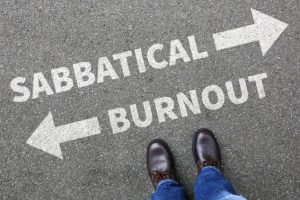
 Obviously I have my thoughts on the above questions that, in my estimate, would form good and fair parameters of a Sabbatical Policy, but I shall, at this time, leave it unsaid except for a couple of things.

 This is particularly evident of churches that use rented shop lots (and in Malaysia, they make up a good majority). As the premises don’t belong to them there may be little ownership and motivation to keep the place in good condition. There is even less sense of responsibility for the common areas, such as the corridors; and public areas, like the five-foot way. I have been to churches where throwaways (by other tenants) were stuffed under the staircase leading to the church in the upper floors, unsightly debris along the five-foot way, and the only-to-be-found-in-Malaysia heinous Ah Long stickers plastered all over the external walls of the buildings.
 In fact, they rightly never stop exercising their gifts. The evangelist still evangelises the lost and the pastor still nurtures people in the faith. They still have to walk their talk; and not just talk about how they used to walk! More than what they had done, it is what they are doing that gives them credibility as they train others. It is from their current experiences of ministry that they can best illustrate and inspire others to do what they are doing.