
Elsewhere I have written that a small group Bible study is best conducted through discussion, and the role of the study leader is not as a teacher but a facilitator (see here). It may be helpful to understand how a discussion works by visualising the dynamics at play in a small study group.1
Teaching
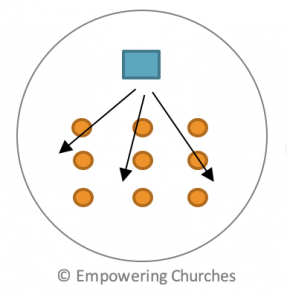 Let me begin by contrasting a teaching situation and a small group discussion. In the classic teaching set-up, the students sit in rows; everyone faces forward and looks at the teacher. They don’t see each other’s faces, only the teacher’s.
The “conversation” is primarily one-directional and a monologue—from teacher to students. The students may raise questions, but only the teacher is expected to give the answers. The teacher is the primary (and often, the only) source of learning for the group.
Discussion
A discussion is depicted diagrammatically (and literally) with all the participants sitting in a circle. The study leader is part of the circle. Sitting in a circle allows everyone to see each other, look into each other’s eyes, observe expressions, engage, and relate with one another.
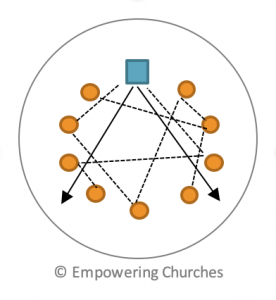 It is not a good idea to have more than one layer of people. No one should be sitting behind another person. Everyone should be able to have eye-contact with every person in the group.
This is especially necessary for the leader who uses eye-contact to convey connection and attention as well as understanding and acceptance to the other participants. More than that, when he (or she) is able to see everyone’s face he is able to read their body language. Are they lost, bored, engaged, or ready for an opportunity to contribute to the conversation?
In a discussion, the study leader leads and facilitates the dialogue (depicted by the solid lines). However, the goal is to get everyone to participate and contribute to the discussion (depicted by the dotted lines).
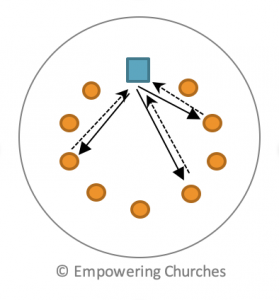 What is important to note is that the lines of communication are not just between the leader and the others, but also between the members of the group. If the conversation were just between the leader and each member, then the dynamics would be a “quiz”. The leader asks a question and someone responds. Then, back to the leader who follows up with a comment and/or another question. The cycle is then repeated. In this case, the leader is not functioning as a facilitator but a quiz master. However, a discussion, by definition, is only assumed to have taken place if members of the group interact with one another. One of the key jobs of the study leader then is to facilitate this interaction between members.
Discussions are Tailored-Made for Cell Groups
Preaching, teaching, and discussion have their particular usefulness. All these means of learning should be employed in the church. Which method is used, however, depends on one, the purpose of the engagement and two, the setting of the learning environment. I won’t repeat what I have written elsewhere (see here).
In the context of a small group or cell group, I believe the primary means of learning should be through discussion—not preaching or teaching. Churches would do well to train all who are tasked with the job of leading the cell group Bible study to ably facilitate good discussions. Discussions that are interesting and engaging. Discussions that help members discover and uncover what the Bible says about the subject under study. And discussions that provoke personal reflection and encourage life application.
 In this regard, the study leader steers the conversation around the topic. He guides the members to make contributions that are relevant to the focus of the study. If the discussion goes awry, the leader brings it back on track. If the discussion gets stuck, he moves it along. If a member of the group isn’t contributing to the conversation, he encourages him or her to participate. If someone is hogging the conversation, he tactfully gets others to share. At the end of the study, he brings the discussion to a close with a clear conclusion; including a take home point from the study.
 The study leader is often temped to answer his own questions, especially when the group is slow to respond. But he must strongly resist! It wouldn’t be a discussion if the leader were to pose a question only to supply the answer himself. This does not mean that the leader does not come prepared with answers. He does. But he only shares it when it’s necessary to do so or by way of rounding off a segment of the discussion and as a conclusion to the study.
 For example, the main purpose of a sermon is not about piling onto the listeners loads of biblical knowledge. Growth in Bible knowledge is more in line with teaching. This is not to say that a sermon has no teaching content. A sermon cannot qualify as a sermon if it is not biblically sound. A sermon must be based on teaching (biblical teaching); but a sermon is not teaching. The purpose of a sermon is to convey God’s message from the Bible. It is a word from God from the Word of God—a message from the passage. The purpose of a sermon is to speak into lives; to encourage, inspire, and correct; leading to life transformation (2 Tim 3:16-17).
 A discussion is active learning through participation. Listening to sermons and Bible teaching are passive forms of learning. It is well documented that people learn better through active participation rather than passive listening.
 The event that sparked the writing of the book was a seminar I did for a young people’s church in October 2019. It was not my first time teaching the material. However, an evaluation the seminar made me realise that there was just too much material for the participants to digest. I decided that it would be better for me to put the teaching into a book so that people can read it at their own pace. They can also take time to think through the principles and apply them into their lives.
 Then, the final part—printing the book. A slot for early March had been set with the printer to print the book. It was rush time for the layout artist to get everything print ready by the deadline. We managed to do that by a whisker. The printer sent me a mock-up of the book for one final check. And even at that final stage there were still typo-errors. Corrections were made and the file was sent to the printers again with a go-ahead. Then came the MCO!…and a wait of nearly three months!
 In the context of Jeremiah 29:13, obviously seeking God is not simply about hearing what the Lord has to say—they had just heard from Him. Seeking God in this case was about the exiles aligning themselves to Him and His purpose. It is one thing to know what the Lord wants—it is another thing to align ourselves to what He says.
 As I spoke, I said to the church, “I don’t know what your expectations are. But, then again, maybe I do. In a crowd like this the expectations are many and varied. You may have gone along on the same journey, but perceptions are different, interpretation of events are different, internalisation of the experiences are different. And depending on what you feel is important you will also expect those things to be addressed as quickly as possible. They are all valid and good. We are all good Christians who want no less than the good of the church. But good must give way to…?”