by Lim Soon Hock
A critical book review of Peter Rowan’s Proclaiming the Peacemaker: Malaysian Church as an Agent of Reconciliation in a Multicultural Society (Minneapolis, MN: Fortress Press, 2012).
- The Malaysian Church and the Theology of Reconciliation
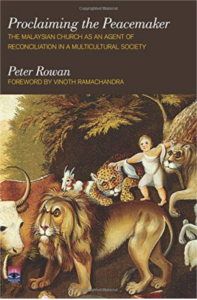 From a survey among Malaysian Christians, the author concludes that while the respondents see peace-building as part of the church’s mission, there is, however, a gap between belief and practice.1 Empirical evidence from the reviewer’s observation bear out the foregoing.
Malaysian Christian national leaders,2 pastors, and church leaders are yet to have a handle on a theology of reconciliation, much less ordinary Malaysian Christians.
Moreover, living out the implications of the biblical expectation is challenging because of the demand of the Malay-Muslim majority to keep Islam dominant in Malaysia. Rowan is aware that Muslims in Malaysia consider Islam to be above other religions.3 For example, Islam is not part of the MCCBCHST.4 Discussions addressing common issues affecting religious sensitivities are not held on equal footing, often prejudiced against non-Muslim religions, and dialogues are not encouraged by some Muslim clerics.5
One of Rowan’s seven key themes for missiological reflection6 is “interfaith co-operation.”7 Living Lee calls for dialogues.8 However, it does not appear that CFM9 or its component bodies have used MCCBCHST as a platform to pursue peacemaking.10
In fact, the other religions perceive Christians to be divisive rather than reconciliatory because of the latter’s evangelistic efforts to convert adherents from other faiths.11 On the flip-side, Malaysian Christians are suspicious of other religions.12
Indeed, reconciliation should begin within the church. Rowan’s second theme is “multiracial congregations.”13 The author advocates for a multi-ethnic expression of the church.14 The reality in the Malaysian church is that congregations are defined by language and ethnicity.
The author seems to imply that the foregoing reality is due to church planting strategies.15 While it may be so, the strategies are likely to be influenced by two other significant factors that are peculiar to Malaysia.
One, the diversity in the language of preference for worship, teaching, and communication in the church. Two, the impact of ethnic separation in Malaysian society on the church. If the latter is to promote a theology of reconciliation in the public square, it has to first practise it within the church.
- The Identity of Malaysian Church and the Willingness to Suffer
Rowan hinges his thesis on the Malaysian Christian’s perception of his or her identity.16 The author understands that Malaysian Christians generally do not have a kingdom identity nor a Malaysian identity;17 rather, they lean toward a Western-Christian identity.18
The reviewer contends that the influence of a Western-shaped Christianity is inevitable since it was missionaries from the West who planted the first churches for most, if not all, denominations (including the vernacular churches).
Second, churches in Malaysia are shaped by teaching from the more developed Western church. Malaysian theologians, teachers, and pastors are yet to provide a distinctive Malaysian-shaped Christianity.19
For there to be a Malaysian Christian identity there must first be a definitive Malaysian identity. However, there isn’t one—a bangsa Malaysia.20 Hence, the former is a difficult task to prescribe.
A second challenge stems from the multi-ethnic composition of the national Malaysian church. Rowan writes that Christian identity is inseparable from who we are in our cultures and societies. That is, kingdom identity should not make us culturally less Chinese or Indian.21
The qualifier for kingdom identity must also be a qualifier for a Malaysian Christian identity. That is, having a Malaysian Christian identity should not make an Iban Christian any less Iban, or a Kadazan Christian any less Kadazan. The concept of a Malaysian Christian identity that does not take away anything of an individual’s ethnic particularities needs to be explored.22
The author cites Hwa Yung who describes Malaysian Christians as having “no clear sense of who they are in Christ,”24
However, the lack of boldness among Malaysian Christians is not because they do not have kingdom identity, rather it is because they fear the consequence of thus living out their identity in a Malay-Muslim dominant country that has shown significant hostility towards the church. Rowan quotes Lim Kar Yong that Malaysian Christians are not prepared to suffer for the sake of the kingdom of God and the gospel.25 The foregoing is evident from emigration statistics.26 There are few like Pastor Raymond Koh who are willing to pay the price for a mission of reconciliation.
Conclusion
Rowan’s Proclaiming the Peacemaker is an important read for all Malaysian Christians, especially pastors and church leaders. The theme of reconciliation and peacemaking as kingdom agenda that is inseparable from the gospel needs to be understood by all Christians.
However, it needs to go further—beyond the theological level. The implications and the applications have to carefully worked out and fleshed out so that Malaysian Christians (and churches) know how to live and act as peacemakers in a multi-ethnic and fragmented Malaysia.
 Let me give you four factors that will help you determine what you may write about, especially if it’s your first book.

 The event that sparked the writing of the book was a seminar I did for a young people’s church in October 2019. It was not my first time teaching the material. However, an evaluation the seminar made me realise that there was just too much material for the participants to digest. I decided that it would be better for me to put the teaching into a book so that people can read it at their own pace. They can also take time to think through the principles and apply them into their lives.
 Then, the final part—printing the book. A slot for early March had been set with the printer to print the book. It was rush time for the layout artist to get everything print ready by the deadline. We managed to do that by a whisker. The printer sent me a mock-up of the book for one final check. And even at that final stage there were still typo-errors. Corrections were made and the file was sent to the printers again with a go-ahead. Then came the MCO!…and a wait of nearly three months!