
Same Word, Different Ways

Christians grow in the Word through four primary ways: sermons, Bible classes, small group discussion, and personal study (including daily devotional reading). They are all important, and none should be neglected.

They have the same ultimate objective – a believer’s growth in the Word (understanding) and through the Word (transformation). However, they don’t do it in the same way. The failure to distinguish them is one of the main reasons why sermons or small group Bible studies don’t impact people as much as they could.

The Sermon

For example, the main purpose of a sermon is not about piling onto the listeners loads of biblical knowledge. Growth in Bible knowledge is more in line with teaching. This is not to say that a sermon has no teaching content. A sermon cannot qualify as a sermon if it is not biblically sound. A sermon must be based on teaching (biblical teaching); but a sermon is not teaching. The purpose of a sermon is to convey God’s message from the Bible. It is a word from God from the Word of God—a message from the passage. The purpose of a sermon is to speak into lives; to encourage, inspire, and correct; leading to life transformation (2 Tim 3:16-17).

If that is the case, then preachers should not pack their sermons with loads of teaching material filled with multiple points and sub-points. To those who do, they should teach less and preach more. Conversely, preachers who tend to preach a point rather than from the biblical text, should make sure that their sermons are based on and derived from the biblical text; preferably from one main passage of the Bible.

Another mark that differentiates preaching from other forms of Bible learning is that a sermon does not allow for much, if any, “conversation” between the preacher and the listeners. This is simply because the nature of a sermon is proclamation rather than dialogue. Secondly, the setting of speaking to a crowd limits any kind of actual dialogue between preacher and listener.1

The Bible Study Discussion

On the other hand, the small group Bible study functions in the opposite way. The study leader is not a preacher; not even a teacher. The role of the study leader is to facilitate a discussion where all the members of the group are encouraged to contribute. The operative word is “discussion”.

There are many good reasons for the use small group discussion to study the Bible.

  1. A discussion is active learning through participation. Listening to sermons and Bible teaching are passive forms of learning. It is well documented that people learn better through active participation rather than passive listening.
  2. In a discussion people are made to carefully think, or closely observe the Bible text before they respond. Similarly, they have to intently listen to what the others in the group are saying in order to meaningfully participate in the conversation.
  3. A discussion affords group learning as the members weigh each one’s contribution to the discussion.
  4. A discussion is more interesting than listening to a monologue. This is especially true if the Bible study leader, say, for a particular cell group meeting, is not a gifted teacher.2 In a discussion, however, regardless of the leader’s level of gifting as a teacher, everyone is invited to participate. It inevitably creates more interest. For example, a view may be shared, which may be affirmed, refuted or refined by others. All this leads to a vibrant group conversation.

I believe most people are able to lead a discussion. Training on how to conduct a group Bible study discussion will certainly help. Following some key pointers on how to conduct a discussion is sufficient for anyone to comfortably lead a discussion. I will write more on this in my next blog post.

You may want to read my article “The Critical Point when Facilitating a Bible Study Discussion.”

Is Your Sermon Predictable?

What is a Predictable Sermon?

Predictability is foreseeing an expected outcome. In the case of a sermon, it becomes predictable when listeners can generally foresee what the preacher is going to say. It may be due to the sermon’s obvious content. Or it may be because the sermon is not only about a well-known Bible subject or text, it is also approached in a rather usual or common way. Or it may be because the preacher has already disclosed the sermon’s main point or points very early in his presentation. All the above scenarios make the sermon predictable.

An example of a predictable sermon comes from the fairly common sermon structure that goes like this:

  • Introduction: Tell the listeners what you are going to say
  • Body: Tell them in a more detailed way what you told them you are going to say (elaboration)
  • Conclusion: Tell them what you just said (summary)

The above structure might be good for teaching—but not for preaching. In the main, teaching is to provide information and understanding about a biblical subject or text. Hence, the above structure is useful to give clarity to the student about what is going to be taught, what is being taught, and what has been taught. This is not to say that preaching does not provide understanding about a biblical subject or text, but the understanding is meant to inspire, encourage, challenge, and change the listener. A sermon must engage both the mind and heart of the listener. Thus, creating and maintaining the interest of the listener is critical.

What’s the Problem with a Predictable Sermon?

The problem with a predictable sermon is that it takes away the listeners’ sense of anticipation for what the preacher has to say (because they already know what he’s going to say). There isn’t a “wait for it…,” intrigue, or a surprise element. When there is little or no sense of anticipation, there will be little or no interest to listen to the sermon.

If a listener is quite well acquainted with the subject matter or has little or no immediate interest in the subject matter, the preacher would have already lost him by the end of the introduction. It is likely that the listener will only wake up when the preacher tells a story, gives an illustration, or cracks a joke! The sermon as a whole does not hold the listener’s attention (that is, interest) because he (or she) is not given any reason to listen with any sense of anticipation.

I believe it is important for every preacher to ask, as he (or she) prepares his sermon, if what he’s going to say next in the flow of his sermon, predictable?

How to Break Predictability in the Sermon?

If predictability is unhelpful to create and maintain listener-interest, then, a preacher must find ways to move away or break the listener’s sense of sermon-predictability. A good starting point is to stop using the sermon structure cited at the beginning of this article. Instead develop sermon structures that do not give away the main thrust of the sermon (namely, the message) until much later. That is to say, there is a “wait for it” element in the movement of the sermon. Some teachers of homiletics have called this movement, “tension and resolution.”

It can be easily seen that predictability is broken and interest is created when a sermon contains a tension to be resolved, a mystery to be uncovered, or a question to be answered. To maintain listener-interest, the resolution should not come too soon. The first part of the sermon should be given toward building up the tension. And the later part of the sermon, to the resolution of the tension. It is even possible to have the resolution right at the end—as the key message of the sermon.

To be sure, the tension, the mystery, the question nor the resolution are plucked from the air; they arise from the Bible text that the preacher is speaking from. In other words, Bible-centred preaching is not compromised in any way.

I believe that if a preacher wants to create and maintain listener-interest, his sermon cannot afford to be predictable. His sermon structure and presentation must be such that it causes his listeners to lean in with an anticipation of discovery.

One Sermon, One Message

by Lim Soon Hock, Empowering Churches

What Preachers and Teachers of Homiletics Say

Many well-known preachers and teachers of homiletics believe that every sermon must have only one message. The following are just a few quotes.

Haddon Robinson, “Students of public speaking and preaching have argued for centuries that effective communication demands a single theme. Rhetoricians hold to this so strongly that virtually every textbook devotes some space to a treatment of the principle. Terminology may vary—central idea, proposition, theme, thesis statement, main thought—but the concept is the same: an effective speech centers on one specific thing, a central idea.”3

John Stott, “…there is a second reason why we should look for each text’s dominant thought, namely that one of the chief ways in which a sermon differs from a lecture is that it aims to convey only one major message.”4

Fred Craddock, “It is better to forget about points. The question is, “What is the point?”…Because the preacher can state his point in one simple sentence, he knows the destination of the trip that will be his sermon. He knows where he is going.”5

Andy Stanley, “Every time I stand to communicate I want to take one simple truth and lodge it in the heart of the listener. I want them to know that one thing and know what to do with it.”6

I’m a firm believer of the “one sermon, one message” homiletical principle. The diagram below is a useful visual to help preachers keep the main message the main focus in their sermons.

The Passage Determines the Message

The first thing a preacher needs to do before he maps out his (or her) sermon is to determine the message the Lord wants him to bring to his listeners. This must arise or be derived from the text(s) he is preaching from. In other words, the passage determines the message. The preacher would be unfaithful to Scripture (and to the Author of the Word) if he were to read something into the text that is not there.

This does not mean that a passage of Scripture cannot have a number of possible messages. The parable of the Lost Son, for example, may be used to preach different messages. The message depends on the preacher’s focus; is it on the prodigal son, the elder brother or the father? The message arising from a focus on the prodigal son may be about repentance, while that on the elder brother may be about self-righteousness, and the one on the father may be about unconditional love. The important factor that cannot be compromised is that the message must be faithful to sound exegesis of the passage.
The Message Drives the Sermon

Once the message has been determined the preacher needs to keep the message constantly in view throughout his preparation. It should be written down in a place where he can easily cast his eyes to help him keep the composition of the sermon on track with the message. He must ensure that the message is driving the sermon.

By this I don’t mean that the message has to be stated at the beginning of the sermon. The message can be stated at a much later part of the sermon. In this case, the earlier parts serve to move the sermon towards the message, or to unravel the message. This is how narrative sermons are often constructed, to create interest and to intrigue the listener.

Not only must the message drive the sermon; everything in the sermon must serve the main message. This includes the sub-points, illustrations, and applications. When discipline is not exercised, the result is overcrowding. Too many things are said, too many diversions chasing after rabbit trails (one is too many). As a result the message is blurred and the impact is lost.

Preacher, let me encourage you to have only one message in your sermon. And everything else in your sermon serves the message. Your illustrations serve to help your listeners visualise the message. And your applications serve to help your listeners actualise the message.

As the saying goes, “The main thing is to keep the main thing the main thing!”

3D Sermon Matrix

by Lim Soon Hock, Empowering Churches


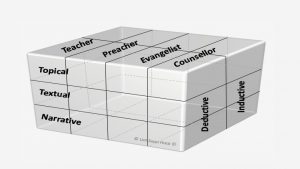
I’m sure you’ve discovered for yourself that sermons come in different forms. To help you recognise the different types of sermons I’ve put together a three-dimensional sermon matrix. When you view a sermon through the matrix you will be able to determine its type.

TOPICAL, TEXTUAL OR NARRATIVE?

The first dimension looks at whether a sermon is (1) topical, (2) textual or (3) narrative. A topical sermon is centred around a subject matter such as Integrity, The End Times, or a Bible character like Abraham. The topic then determines the Bible texts to be used. They may be taken from any part of Scripture as long as they are relevant to the subject. On the other hand, a textual sermon starts with the Bible text. The text may be a verse, a passage or even a whole book, which then determines the contents of the sermon.

The narrative sermon is not so easily defined as there are varied views about what it is. One important view is that the narrative sermon is not just a sermon based on a Bible story. For that matter, it may not even have any stories in it. Rather, what the narrative sermon employs are the elements found in stories; such as tension, resolution, and plot, which shape the sermon.

You may have noticed that I’ve not included “expository” in the list. I believe all sermons should be expository. By “expository” I mean the message must be derived from and be faithful to the Bible text. In other words, a topical sermon must be no less faithful to the Bible texts that it is based on as much as a textual sermon. A topical or narrative sermon is to be just as expository as a textual sermon.

DEDUCTIVE OR INDUCTIVE?

The second dimension is about whether a sermon is (1) deductive, or (2) inductive. In plain terms, a deductive sermon begins with a thesis or a proposition. The rest of the sermon is an elaboration of the thesis or a presentation of the points that support the proposition. The inductive sermon is the exact opposite. The preacher takes the listener with him (or her) along the journey of detection until both arrive at the conclusion or message together. Simply put, the deductive sermon is declarative while the inductive sermon is discovery.

TEACHER, PREACHER, EVANGELIST OR COUNSELLOR?

The third dimension concerns how the speaker perceives his role in the pulpit. Does he see himself as a (1) teacher, (2) preacher, (3) evangelist, or (4) counsellor? A speaker can assume any one of the four role-types depending on his gifting and his philosophy of preaching, which might be modified depending on the crowd he is addressing and the purpose of the sermon.

What I’m going to say next is certainly an oversimplification, but it will give you an idea of how a speaker might present his sermon if he were inclined to be one of the above types. A teacher would spend more time explaining the Bible text so that his listeners understand the truth of the Scripture he is addressing. A preacher would be more focussed on bringing home the sermon’s message and moving the people to act on it. An evangelist’s prime objective is get the Gospel message to the unbelievers in the crowd. While a counsellor is concerned about giving good biblical and Christian counsel through his sermon to help and encourage his listeners.

viewing through the 3D sermon matrix

A sermon then, can be a combination of any of the elements from the three dimensions. Some elements come together much more naturally. For example, teachers tend to be more textual and deductive. A narrative sermon by definition would be inductive. On the other hand, a topical or evangelistic sermon may be approached deductively or inductively.

I appreciate that many sermons may not be so easily classified as one type or another. Nonetheless, analysing sermon types using this 3D sermon matrix is helpful to understand a preacher’s approach to his sermon presentation. And if you are a preacher, the matrix will help you understand your default mode of sermon presentation. Maybe, now that you’ve learnt something from the 3D sermon matrix it will help you venture to try out other types of sermon presentations.

Seeking God (Part 1): First Thing

It was my first Sunday at the new church; my first message to the congregation. What would I say? I think most pastors struggle. I did. Not that I don’t have anything to say. If you are a fairly seasoned pastor, you have, in fact, too many things to say; so many issues to address; so many things to do. But what should be the first thing on the agenda?

As I spoke, I said to the church, “I don’t know what your expectations are. But, then again, maybe I do. In a crowd like this the expectations are many and varied. You may have gone along on the same journey, but perceptions are different, interpretation of events are different, internalisation of the experiences are different. And depending on what you feel is important you will also expect those things to be addressed as quickly as possible. They are all valid and good. We are all good Christians who want no less than the good of the church. But good must give way to…?”

I stopped for a dramatic pause.  Not expecting any kind of verbal response from this fairly conservative middle class medium-size congregation. But an extrovert shot out, “Better!” I hesitated. Seeing that was not quite what I was looking for, she shouted out again, “Best! Good must give way to best!

I said, “That’s good, but it’s not good enough. Good must give way to?… God! And it’s more than just dropping an “o”. There is a huge gap between good and God. It is God we want, not just good. It is God that we want to glorify, not to showcase how good our church is. That means, we must want to do the God-thing, not just good things.”

In order for us to do the God-thing, we need to hear from the Lord—to hear what His agenda is for the church or our ministry, our life and our vocation. Sometimes we run ahead of God, doing things He never meant for us to do. More often than not, we lag way behind, failing to do what He says we are to do. However, I think, the reality is that we haven’t a clue what God is up to, because we have not been listening to what He’s been saying. To do the God-thing, it is imperative that we hear from the Lord. And in order to hear from the Lord, we need to seek Him. That’s the first thing on our agenda—to seek God for His agenda, whether it’s for our life or for the church.

Lim Soon Hock Empowering Churches

(For Part 2 click here)

Preaching the Same Sermon Again (…and again)

When I was pastoring a church I preached largely to the same people each Sunday. Obviously, it had to be a different sermon. That’s the challenge of a pastor: to bring a fresh message from the Word to the same faithfuls. The upside is that it keeps you studying and growing, besides stretching your creativity so that the faithful won’t find you boring.

Now that I am no longer a pastor of a church, I get to preach in different churches. The temptation for me is to choose my “better” sermons and recycle them. After all, as someone said, “If a sermon is not worth repeating, it is not worth preaching in the first place!” The downside is that it can make a preacher lazy; you don’t study as much anymore, so you don’t enlarge and grow. Furthermore, recycled sermons will not come out as fresh as when you first prepared and preached it to the original group.

I believe the same applies to seminars. Something that I am doing much more now than I used to when I was pastoring a church. Usually it will be a seminar from among my repertoire that you find listed in the website’s Seminar page (http://empoweringchurches.my/seminars/). But just as often I will be asked to do something that’s not in the list. My first reaction would be, “Oh boy, more work!” But, inevitably it will turn out to be better for everyone, including me.

It’s good for those at the receiving end because they get something fresh; not something that I just pull out from the files. It will be material that I have taken time to research and study, thought and worked through from almost ground zero. “Almost”, because I can only teach on areas that I am fairly well versed in; I will not teach on a subject that I have little understanding or experience.

Furthermore, as I am preparing to teach this new material I will inevitably be thinking of the people or the church, and the context of their experience. In other words, I tailor-make the content, structure and style of the seminar to them.

The bottom line for all of us preachers and teachers of the Word is that we need to keep ourselves spiritually fresh so that there is a freshness when we preach and teach, even if we might be reusing a sermon or seminar material. If a sermon or seminar doesn’t excite you anymore, even if has a proven track record, don’t preach or teach it. It won’t come-off in the same way—it won’t take off. We are short-changing the people who have come to listen to us.

If I were to repeat a sermon or seminar material I would rework it; throw out the not-so-useful stuff and add in new and better material. I would ask the Holy Spirit to tell me what I should emphasize for this particular group of people or church. I would try and tailor-make it for the people who have so graciously invited me to minister to them. Most of all I want to honour Jesus who called me to this awesome service!

Preaching and Teaching are Not the Same Thing

Preach the WordI believe that the failure to make a distinction between preaching and teaching is one of the key reasons for poor sermons. Sermons that are more teaching in content and style of presentation but attempt to pass off as preaching is a serious cause of disconnect between the preacher and the people in the congregation. The what and the why of preaching and teaching are different, and hence, when  a speaker employs them depends on whether he is preaching or teaching.

To understand the difference between the two we must first look at their respective purpose. The purpose of teaching is to help people understand the Bible and it’s truths; to help the listeners know about God and what He has said. Broadly speaking, teaching addresses the mind more than the heart. This does not mean that the teacher does not challenge his students to apply the Word into their lives. He does, and he must, as teaching of the Bible has to lead to life-change.

On the other hand, the purpose of preaching is to help people hear what the Word of God is saying to them now. It targets the heart; to inspire, challenge and cause the listeners to apply God’s Word in their lives—leading to life-change.

The sermon at a worship service is where preaching ought to take place. However, in many churches (across all denominations, but especially among conservative evangelical churches) teaching makes up the bulk of the sermon. Explanation is given by the preacher about how he had arrived at his interpretation. He may go into the original language, provide the historical context of the Bible text, take the listeners on a tour of the geography, give the different possible interpretations as he quotes this and that scholar, and refers to other Bible references to underscore his interpretation, but he never gets to the address the question, So what?

What? is what teaching focuses on. So what? is what preaching should focus on. It is the message of the passage; the big point of the sermon. It cannot be left to the last five minutes of the sermon; the preacher would have lost his listeners to the message because he had lost them with his elaborate explanation of the text. The message may be hinted at early in the sermon;  certainly it must be developed as the sermon is preached, with plenty of time for amplification and application after the thrust has been stated. For a sermon to have been effective, the listeners must go away knowing clearly what the message was about and be impacted by it.

Is teaching not important in a sermon? It certainly is—very important, because the message is based on the Bible. In other words, teaching must be the basis of the preaching; teaching must inform the preaching. However, in a sermon the teaching content cannot take a disproportionate amount of time. The preacher does not do his exegesis at the pulpit; he does that in his study. At the pulpit he preaches the message that he has distilled from his study, having sought the Lord in prayer, and under the inspiration of the Holy Spirit.

The pulpit at the weekly worship service is not the place to do teaching (I should qualify that with the word “elaborate”). Bible classes and special seminars are the places where more in-depth Bible teaching happens. And that, we must have in our churches. Christians must be know the Word of God; they must be taught the Bible. But not through the sermon at the weekly worship service (don’t take this sentence out of context!). The purpose of preaching is to bring a message from the Lord based on the Word of God to the listeners that they need to hear now.