Re-Envisioning Vocational Christian Ministry in the Church in Malaysia in Light of Change (Part 3)

by Lim Soon Hock, Empowering Churches

This paper was written in November 2020 when the government of Malaysia imposed restrictive curbs, SOPs, and lockdowns to prevent the spread of the coronavirus (Covid-19). This significantly affected the activities of the church.

Click here for Part 2, and here for Part 1

A REVIEW OF THE ROLE OF THE VOCATIONAL MINISTER IN THE MALAYSIAN CHURCH IN LIGHT OF A CHALLENGING CHANGE

As we review the role of the vocational minister in the Malaysian church, the first point to note is that change in and around the church does not alter the minister’s ministry functions.  However, change may alter his emphasises from among his varied functions and how he carries out his functions.

An example is from the changing size of a church.  Gary L. McIntosh posits that churches have different needs depending on size.  A small church is not just a miniature version of a large church but an entirely different entity.1  Hence, as a church grows from small to medium-size to large the dynamics of the church also changes.  This does not only affect the church’s structure, orientation and strategies but also the pastor’s role.2

Change in or outside the church always demands a response if it is to be positively addressed.  On one hand it should be met with a response of consistency concerning the purpose and values of the church.  On the other hand, it should be met with a recalibration of the priorities and methodology of doing church and ministry.

The Minister’s Leadership Function

In a crisis brought about by change, among the three functions of leading, feeding and caring, the minister must prioritise his leadership function.  He needs to study the change, the effects of the change and how to address the change.  He doesn’t do this alone but with his leadership team.  Nonetheless, it is incumbent upon the minister to take the lead.  Leadership is a key function of the vocational minister. He cannot surrender that role to anyone.

The Use of Technology3 and Online Platform

The biggest visible change in the Malaysian church as a response to the effects of the  pandemic has been the adoption of the online platform as a substitute or as a complement to limited onsite meetings.  When the Movement Control Order was first enforced in Malaysia on 18 March 2020 churches all across the country were caught totally unprepared (except a few churches that already had an online presence).  Churches responded with varying degrees of rapidity, expansiveness and intensity in their adoption of the online platform.


Some churches immediately started to learn and use the available technology to livestream their worship services.  Most churches were slow to adopt the new technology.  Some were quick to make use of existing digital communication tools for small group meetings and to provide daily or weekly devotional content for their members.  Others felt challenged by the new technology or were stretched by their limited resources.  Some churches made significant financial investment to upgrade their equipment for quality virtual broadcast.  Many simply hoped and prayed that all this would quickly pass and the church would be able go back to do church and ministry like the time pre-Covid-19.

These varying degrees of responses from churches in Malaysia underscore the importance of the leadership function of the minister.  In other words, the minister’s leadership determines how his church responds to change.4  Moreover, a church’s response to external changes demands internal changes.  Managing congregational changes requires wise, Scripture-guided and clear leadership from the minister.

The Unchanging Purpose of God and His Church

More importantly, the minister’s leadership is needed to direct the church in a “long obedience in the same direction.”5  Priorities and methods may change, but the purpose and values of the church do not change.  The minister must constantly and continually lead the church towards the purpose of God as revealed in Scripture.  Foremost, in terms of the mission of the church, is to make disciples of the nations (the Great Commission, Mt 28:18-20).

Hirsch and Ferguson contend that,

“…Jesus gets the privilege of decisively defining the movement that claims his name; nonetheless, leaders in his church need to take this task of defining the parameters of how people think about the church with utmost seriousness.  Allowing Jesus to guide us, it is part of the leadership task to somehow manage how the rest of the organisation as a whole sees itself and its function in the world.  In other words, it’s the leaders’ job to define ecclesia for the people and organization they lead.

This puts a huge theological responsibility on leadership to ensure they have a vision of the church that is consistent with the church Jesus built.  We cannot shirk this, especially in moments of crisis that require accurate recalibration.”6

What is the recalibration that is needed to fulfil the Great Commission in this new season where mass gatherings are curtailed?  The answer must be in small groups.  The ministry of small groups is not new, but in this new season it needs to be emphasised and reconstructed.  The minister needs to lead the charge in reconstructing the small group ministry of the church.  For example, the small group needs to become even smaller.  12 may no longer work.  20 is certainly unworkable.  Six might be ideal.  Also, the general thrust of the small groups in coming together for Bible study and fellowship is not significantly focussed enough if the church is to fulfil the purpose of the Great Commission.  The thrust of the small groups has to be disciple-making and life-on-life discipling.7  In this regards the minister needs to provide the leadership model of discipling in small groups in his church.8

The Minister as Trainer

The minister obviously cannot carry out discipling by himself.  He needs to multiply himself.  In other words, he needs to empower others to do the same (2 Tim 2:2).  He has to see himself as one of God’s gifts to the church whose function is to equip the saints for the work of ministry (Eph 4:11-13).  And the area which he is to equip his church is naturally in the area of his giftedness or expertise, which is to shepherd or disciple others.9  Hence, the pastor reproduces according to his own kind.10

Colin Marshall and Tony Payne call for ministry mind-shifts.  Their list of 10 ministry mind-shift items includes: from running programmes to building people, from running events to training people, from relying on training institutions to establishing local training, from engaging in management to engaging in ministry and from seeking church growth to desiring gospel growth.11

They propose a mental image of the pastor as trainer who functions as a preacher and trainer, instead of a clergyman who is a preacher and service-provider or a CEO who is a preacher and manager.12  Their comparative chart of the three images of the pastor is helpful.13

The same sentiment is shared by William Willimon.  In A Reader for Ordained Ministry he discusses a number of images of the 21st Century pastor that includes the more far flung images of media mogul and political negotiator and the more commonly held images of preacher and servant.  He asserts that it is the nature of the Christian ministry to be multifaceted and multidimensional.  He insists that the “gospel does not change, but the context in which the gospel is preached and is enacted do change.  A predominate pastoral image might have been fruitful in one age may not be so in the next.”14  Nonetheless, because the Christian ministry is significantly countercultural, Willimon says he finds “much to be commended in the image of the pastor as a missionary, or more accurately, a lead missionary or equipper of the missionaries.”15  The last point is key to the minister’s function in the present and challenging season of change.  The minister’s function is not only to lead his church to fulfil the unchanging commission of disciple-making, but also to train and empower his church for this same purpose.

The church member, who has been thus trained, may not be called nor able to preach in a large meeting, but he can carry out a disciple-making ministry with a small group of people.  During this season where large gatherings are curtailed this makes for a significant ministry strategy.  A next step might be for the vocational minister to further train and release able men and women to start new churches in their neighbourhood and places of work; in fact anywhere, where they can engage non-believers and disciple believers.  It is time for a mental shift, to stop thinking of church in terms of church gatherings, but to be the church everywhere.  This is in total alignment with the NT concept of the church, which is simply a people gathered, centred around Christ and in mission for the Kingdom.16

CONCLUSION

The Malaysian church may not be aware, or may not want to admit, that its subservience to its institutionalised nature has made it quite impotent.  The needs of the members, the programmes of the church, and keeping the church establishment intact are more important than the mission of the church.  That being the case, in a season when the church is hit hard with an external and challenging change the prevailing mindset of the church cannot effectively respond to the change.  Neither can it keep its focus on its mission.

It is the role of the vocational minister to provide leadership for the church to respond to the change.  No doubt, the minister’s function is also to feed and care for the sheep whom the Lord has entrusted to him, but in a season of change he needs to step-up in his leadership function to lead the church to fulfil the unchanging purpose that God has for His church, namely, to make disciples of the nations.

The vocational minister can do this best by multiplying himself through training his members to be disciple-makers.  In the present challenge when the church gathered needs to go small, the move to disciple-making in small groups is ideal.  Perhaps, these empowered disciples can even start small churches where the Lord has put them.  It is not difficult to envision a movement of organic churches17 mushrooming all over a city, a nation and in the nations of the world.  This is perhaps the answer to lockdowns due to a pandemic or in times of persecution.  And it might very well lead to a movement that Keller, Hirsch and Ferguson speak about in their books.

Re-Envisioning Vocational Christian Ministry in the Church in Malaysia in Light of Change (Part 2)

by Lim Soon Hock, Empowering Churches

This paper was written in November 2020 when the government of Malaysia imposed restrictive curbs, SOPs, and lockdowns to prevent the spread of the coronavirus (Covid-19). This significantly affected the activities of the church.

Click here for Part 1

A DESCRIPTION OF THE VOCATIONAL MINISTER IN THE MALAYSIAN CHURCH

Hovorun’s point about self-awareness is also applicable for the vocational minister.  The vocational minister needs to be aware of his person, role and functions as a minister in the church.  Self-awareness allows for self-evaluation and self-correction.

In the Malaysian church the general perception is that the role of the vocational minister is to carry out pastoral functions and to meet the pastoral needs of the members of the church.  A simple example is the expectation of members for the main pastor to visit them in hospital and pray for them.  It is not enough that another pastor or a lay-leader visits and prays for them—it must be the main pastor.  The unfortunate result arising from the institutionalism of the church is the perception and expectation that the work of the pastor is to keep the church serviced.

The minister by nature of his role has many functions.  Seward Hiltner in Ferment in the Ministry lists at least nine important functions: preaching, administering, teaching, shepherding, evangelising, celebrating, reconciling, theologising and discipline.18  With so many and varied ministerial functions what should be the overarching function of the minister if he were to make sense and prioritise his varied functions?

The New Testament Image of the Vocational Minister

The NT word for the pastor is poimēn which means shepherd.19  The term is mostly applied to Jesus (Jn 10:11, 14, 16, Heb 13:20, 1 Pet 2:25, Rev 7:17) and once to describe one of the four kinds of men that the Lord gifts to the church (Eph 4:11).  Cognates of poimēn in the NT include poimainō,20 poimnē,21 and poimnion.22  They are used literally for vocational shepherds and their work of tending their sheep, and also figuratively of Jesus and church leaders and their work of ministry among the people under their care. The use of poimēn and its cognates makes the shepherd imagery an apt description for the minister.

The shepherd imagery, with cues from Psalm 23:1-4, sums up the primary role of the minister as leading, feeding and caring for the people in the church.  Leading includes leading the people to the Lord, to grow in their relationship with Jesus and to learn faith and dependence on Him (Gal 4:19).  It also means leading the church collectively towards the purpose of God (Acts 13:1-3, 15:1-35).  Feeding includes teaching the people the Word of God; its truth and application in their lives.  It also involves training them to be effective disciples and workers in the Kingdom of God (Eph 4:11-13, 2 Tim 2:2).  Caring includes spiritual nurturing, binding up the wounds of the soul through counselling and prayer (Js 5:13-16) and protecting the flock from false teaching (Acts 20:28-35).

The Role of the Vocational Minister in the Malaysian Church

As we return to the description of the vocational minister in the Malaysian church, it is clear that among the three functions of leading, feeding and caring, the caring function is the one most expected of the minister.  The least expected is the leading function, and especially in relation to directing the church towards God’s purpose for the church.  I will pick up on this point in the subsequent section of the paper.  The feeding function lies  between the above two functions in terms of what is expected of the minister.

The church in general may recognise the importance of the minister’s role in feeding the flock with the Word of God but in reality they do not place the minister’s teaching function as important as caring for their needs.  I have observed that many churches do not adequately provide the minister with time and resources to empower him to be an apt teacher of the Word.  Neither do they make the minister’s teaching function his primary role in the church.

Chow Lien Hwa’s article in the SEA Journal of Theology calls for a minister to be a theologian in his church.  It is important because, as Chow says, the minister-theologian has the ability to contextualise theology for his area.23  Sunny Tan Boon Sang echoes the sentiment in a review of Chow’s article, “A resident pastor-theologian would be one who could devote himself/herself to the ongoing task of facilitating and supervising the work of theology in a local church.”24  This reminder is even more critical in the context of change because the ability of the minister to determine and lead a right response to the challenge of change requires sound understanding and teaching from Scripture (2 Tim 2:15).

Go to Part 3

Re-Envisioning Vocational Christian Ministry in the Church in Malaysia in Light of Change (Part 1)

by Lim Soon Hock, Empowering Churches

INTRODUCTION

The Covid-19 pandemic and the SOP set in place in Malaysia to control it have affected the church and its ministries.25  One of which is the curb on large group meetings.  The traditional church thrives on large meetings.  This is true of ministries within the church like the worship service and also those outside the church like its community services.  This global pandemic has caused, or rather, forced, the church to rethink about how it should do ministry.  In fact, in view of the changes that are taking place in and around the church, it also needs to rethink its ecclesiology,26 and the vocational minister needs to rethink his27 role.

The primary purpose of this paper is a re-envisioning of the role of the vocational minister in light of the aforementioned mega change that is affecting the church and its ministries.  The vocational minister refers to the main pastor of the church.  Nonetheless, in most instances, the discussion is applicable to other pastors in a multi-staff church, as well as to bi-vocational and church leaders who see Christian ministry as their primary vocation.  The minister’s role, however, cannot be separated from the church and its ministry.  Inevitably we have to also discuss issues pertaining to the nature of the church and notions of its ministry.

This paper is an engagement in practical theology, in that it is about the theology of ministry.  Hence, the discussion uses and interfaces with the four commonly accepted ways of doing theology: Scripture, reason, tradition and experience.28  A final point to note about the paper is that while the discussion may be applicable to churches world-wide because of the global effects of Covid-19, the context of this paper is limited to the church in Malaysia.

A DESCRIPTION OF THE MALAYSIAN CHURCH

The best way to describe the Malaysian church regardless of its denomination, language group and size is to tag it with the label “institutionalised.”  At first glance this may appear appropriate since religion is one of the five major institutions of society.29

For our purpose an institution is defined as an establishment with a firmly set purpose, structures and code of practice.30  Timothy Keller in Center Church argues that organisations should have both institutional characteristics and movement dynamics.31  He quotes Hugh Helco, “To live in a culture that turns its back on institutions is equivalent to trying to live in a physical body without a skeleton or hoping to use a language but not its grammar.”32  In other words, as Keller observes, institutions bring order to life.33

Institutions are important and necessary, but they also have several negative characteristics.  They include, the process of decision making that is procedural and slow, innovation is from top down and implementation is done in departmental silos.  An institution may be stable but they are slow to change, their emphasis is on traditions, the past and customs, and future trends are dreaded and denied.34

Alan Hirsch and Dave Ferguson concur when they say,

“…their [institutional structures] intent is almost always good.  Even so, concretized institutionalization does tend to block some of the most powerful aspects of ecclesia as Jesus intended it: a potent social force and gospel phenomenon that sweeps through populations.  Any reading of history, Christian or otherwise, shows that institutional religion can become repressive, stifling creative expressions.

One of the most fundamental reboots we need to do in our day is to rediscover ourselves as the same potent, transforming people movement that started with Jesus and went on to change the world.  The institutional forms have gotten us where we are now and can’t take us farther.  We need to become a people-movement again.”35

Very often with institutionalisation comes institutionalism, and very soon the church is beset with traditionalism and conservatism.  As a result it is not be able to respond quickly and innovatively when confronted with change.  In fact, it may not want to for fear of betraying its long-held beliefs, values and practices.

If this description of the Malaysian church is correct, then the church needs to do some self-evaluation.  However, self-evaluation can only take place if there is self-awareness.  The concept of the church’s self-awareness is discussed at length in Cyril Hovorun’s Meta-Ecclesiology.  He argues that at different epochs of history the Church encountered challenging situations.  They may be spiritual, intellectual, social or political in nature or the result of other historical circumstances.  The challenges of these situations necessitated a response from the Church concerning its self-perception.36

Hovorun’s thesis is helpful for the Malaysian church.  The effects of the Covid-19 pandemic has brought about a huge challenge to the church—which might even be termed a crisis.  How is the church responding?  Will its response enable the church to thrive and advance the cause of the Kingdom of God?  This is dependent on the level of the church’s self-awareness.  The fundamental question that needs to be asked is: Can the Malaysian church see itself beyond its institutionalised nature?

The New Testament Concept of the Church
The New Testament (NT) concept of the church was not that of an institutionalised church.  The institutionalised church is a product of the evolving concept of the church over time as it became more organised, more structured, more rigid, and hence more institutionalised.

The writers of the NT used ekklēsia to term the Christian community.  In antiquity the term was used for an assembly, as in a regularly summoned political body.37  The people who make up the church then, are those who have been called out to gather as the people of God who hold in common a confession of Jesus Christ as their Lord and Saviour (Mt 16:16, 18, Acts 2:47, 1 Tim 3:15-16).

The foremost characteristic of the church would be the centrality of Christ.  Secondly, it’s about a people coming together for the same cause.38  The church may come together for many Christ-centred purposes (Acts 2:42-4), but its ultimate cause is to be empowered and sent out by the Holy Spirit on a mission (Acts 1:8; 13:2-3) centred around Christ’s work of redemption (1 Cor 11:23-26) leading to God being glorified (Eph 3:21).  This cause, or the primary work of the church and of every individual Christian, is most succinctly captured in Matthew 28:18-20, otherwise known as the Great Commission.

This NT concept of the church has direct implications on how the Malaysian church ought to perceive itself and its primary mission, and also how the vocational minister ought to perceive himself and his primary function.

Go to Part 2

One Sermon, One Message

by Lim Soon Hock, Empowering Churches

What Preachers and Teachers of Homiletics Say

Many well-known preachers and teachers of homiletics believe that every sermon must have only one message. The following are just a few quotes.

Haddon Robinson, “Students of public speaking and preaching have argued for centuries that effective communication demands a single theme. Rhetoricians hold to this so strongly that virtually every textbook devotes some space to a treatment of the principle. Terminology may vary—central idea, proposition, theme, thesis statement, main thought—but the concept is the same: an effective speech centers on one specific thing, a central idea.”39

John Stott, “…there is a second reason why we should look for each text’s dominant thought, namely that one of the chief ways in which a sermon differs from a lecture is that it aims to convey only one major message.”40

Fred Craddock, “It is better to forget about points. The question is, “What is the point?”…Because the preacher can state his point in one simple sentence, he knows the destination of the trip that will be his sermon. He knows where he is going.”41

Andy Stanley, “Every time I stand to communicate I want to take one simple truth and lodge it in the heart of the listener. I want them to know that one thing and know what to do with it.”42

I’m a firm believer of the “one sermon, one message” homiletical principle. The diagram below is a useful visual to help preachers keep the main message the main focus in their sermons.

The Passage Determines the Message

The first thing a preacher needs to do before he maps out his (or her) sermon is to determine the message the Lord wants him to bring to his listeners. This must arise or be derived from the text(s) he is preaching from. In other words, the passage determines the message. The preacher would be unfaithful to Scripture (and to the Author of the Word) if he were to read something into the text that is not there.

This does not mean that a passage of Scripture cannot have a number of possible messages. The parable of the Lost Son, for example, may be used to preach different messages. The message depends on the preacher’s focus; is it on the prodigal son, the elder brother or the father? The message arising from a focus on the prodigal son may be about repentance, while that on the elder brother may be about self-righteousness, and the one on the father may be about unconditional love. The important factor that cannot be compromised is that the message must be faithful to sound exegesis of the passage.
The Message Drives the Sermon

Once the message has been determined the preacher needs to keep the message constantly in view throughout his preparation. It should be written down in a place where he can easily cast his eyes to help him keep the composition of the sermon on track with the message. He must ensure that the message is driving the sermon.

By this I don’t mean that the message has to be stated at the beginning of the sermon. The message can be stated at a much later part of the sermon. In this case, the earlier parts serve to move the sermon towards the message, or to unravel the message. This is how narrative sermons are often constructed, to create interest and to intrigue the listener.

Not only must the message drive the sermon; everything in the sermon must serve the main message. This includes the sub-points, illustrations, and applications. When discipline is not exercised, the result is overcrowding. Too many things are said, too many diversions chasing after rabbit trails (one is too many). As a result the message is blurred and the impact is lost.

Preacher, let me encourage you to have only one message in your sermon. And everything else in your sermon serves the message. Your illustrations serve to help your listeners visualise the message. And your applications serve to help your listeners actualise the message.

As the saying goes, “The main thing is to keep the main thing the main thing!”

3D Sermon Matrix

by Lim Soon Hock, Empowering Churches


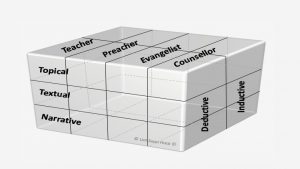
I’m sure you’ve discovered for yourself that sermons come in different forms. To help you recognise the different types of sermons I’ve put together a three-dimensional sermon matrix. When you view a sermon through the matrix you will be able to determine its type.

TOPICAL, TEXTUAL OR NARRATIVE?

The first dimension looks at whether a sermon is (1) topical, (2) textual or (3) narrative. A topical sermon is centred around a subject matter such as Integrity, The End Times, or a Bible character like Abraham. The topic then determines the Bible texts to be used. They may be taken from any part of Scripture as long as they are relevant to the subject. On the other hand, a textual sermon starts with the Bible text. The text may be a verse, a passage or even a whole book, which then determines the contents of the sermon.

The narrative sermon is not so easily defined as there are varied views about what it is. One important view is that the narrative sermon is not just a sermon based on a Bible story. For that matter, it may not even have any stories in it. Rather, what the narrative sermon employs are the elements found in stories; such as tension, resolution, and plot, which shape the sermon.

You may have noticed that I’ve not included “expository” in the list. I believe all sermons should be expository. By “expository” I mean the message must be derived from and be faithful to the Bible text. In other words, a topical sermon must be no less faithful to the Bible texts that it is based on as much as a textual sermon. A topical or narrative sermon is to be just as expository as a textual sermon.

DEDUCTIVE OR INDUCTIVE?

The second dimension is about whether a sermon is (1) deductive, or (2) inductive. In plain terms, a deductive sermon begins with a thesis or a proposition. The rest of the sermon is an elaboration of the thesis or a presentation of the points that support the proposition. The inductive sermon is the exact opposite. The preacher takes the listener with him (or her) along the journey of detection until both arrive at the conclusion or message together. Simply put, the deductive sermon is declarative while the inductive sermon is discovery.

TEACHER, PREACHER, EVANGELIST OR COUNSELLOR?

The third dimension concerns how the speaker perceives his role in the pulpit. Does he see himself as a (1) teacher, (2) preacher, (3) evangelist, or (4) counsellor? A speaker can assume any one of the four role-types depending on his gifting and his philosophy of preaching, which might be modified depending on the crowd he is addressing and the purpose of the sermon.

What I’m going to say next is certainly an oversimplification, but it will give you an idea of how a speaker might present his sermon if he were inclined to be one of the above types. A teacher would spend more time explaining the Bible text so that his listeners understand the truth of the Scripture he is addressing. A preacher would be more focussed on bringing home the sermon’s message and moving the people to act on it. An evangelist’s prime objective is get the Gospel message to the unbelievers in the crowd. While a counsellor is concerned about giving good biblical and Christian counsel through his sermon to help and encourage his listeners.

viewing through the 3D sermon matrix

A sermon then, can be a combination of any of the elements from the three dimensions. Some elements come together much more naturally. For example, teachers tend to be more textual and deductive. A narrative sermon by definition would be inductive. On the other hand, a topical or evangelistic sermon may be approached deductively or inductively.

I appreciate that many sermons may not be so easily classified as one type or another. Nonetheless, analysing sermon types using this 3D sermon matrix is helpful to understand a preacher’s approach to his sermon presentation. And if you are a preacher, the matrix will help you understand your default mode of sermon presentation. Maybe, now that you’ve learnt something from the 3D sermon matrix it will help you venture to try out other types of sermon presentations.

Church Strategic Planning Literature Review (Part 3)

(Click here for Part 1 & here for Part 2)

THE CONGREGATIONAL-CULTURE STRATEGY

The quote, “Culture eats strategy for breakfast” has been attributed to management guru Peter Drucker.43  The statement implies that the culture of an organisation determines its success regardless of how effective its strategy may be.44  Hence, nurturing a healthy corporate culture that everyone buys into is critical to the success of the organisation.  In view of the foregoing statements it may appear that the term “congregational-culture strategy” is self-contradictory.  I am referring to the need for a church to attend to its congregational culture as a strategic means for its health.

Aubrey Malphurs, in his book Look Before You Lead: How to Discern & Shape Your Church Culture, defines a church’s congregational culture as “its unique expression of its shared values and beliefs.45  That means, one, a church’s congregational culture is made up of three components: its beliefs, values and behaviour.46  Two, these beliefs and values are held in common by the majority in the church.47  Three, these shared beliefs and values are seen in the expressions or behaviour of the people in the church which gives the church its unique identity48 vis-à-vis another church that, for the same reason, has its own distinct congregational culture.

Malphurs use of the term “beliefs” is not about a church’s doctrinal position but as it concerns the fundamental aspects of the church’s congregational life.49  These beliefs are convictions that the people in the church assume to be true and they are not subject to rational proof.50  It is from the root of its beliefs that a church’s values are formed.51  The values tell us why a church does what it does.52  However, they only become actual values when they are acted on.  Those values that are not acted on remain merely as aspirational values.53  When the values are acted on they are seen in the behaviour of the people in the church, which becomes the outward or visible evidence of its congregational culture.

If the culture of a church is vital to the success of the church, it is inevitable then, that conscious effort is taken to shape the church’s culture so that it produces a healthy church.  Malphurs states that the person that has the greatest responsibility to shape a church’s culture is the pastor.54  It is by no means an easy task, because shaping congregational culture requires change.  Malphurs explains the preparation, personnel and process required to shape the culture of a church.55  Preparation includes praying for change, doing a church analysis, reading the church’s culture, and managing change.56  Process includes reading the church’s current culture, thawing out the current culture, transitioning the culture to a new level, and re-forming the new culture at the new level.57  Personnel is about the kind of person the pastor ought to be if he is to successfully steer the church to a culture change.

Malphurs other book Advanced Strategic Planning: A New Model for Church and Ministry Leaders58 is a useful companion to Look Before Your Lead.  Although the former was written before the latter, the right order to read the books would be the latter before the former.  Look Before You Lead provides the big picture about the necessity to shape congregational culture for church health and the steps that a pastor or church leaders may take to bring about the needed change.  Advanced Strategic Planning goes into the nuts and bolts about developing a church’s core values, mission and vision statements, and ministry strategy.

The importance of shaping congregational culture as a strategic means for developing healthy churches is found in Malphurs’ statement, “we’ve discovered that it’s a waste of time and money to attempt to lead a culturally toxic church that clings to the traditions of men rather than the clear teaching of Scripture through the strategic-envisioning process.”59  In light of this statement, shaping congregational culture is an indispensable requirement to develop healthy churches.  One of the research questions in Matthew C. McCraw’s dissertation made this inquiry, “Of the local churches that possesses a healthy organizational culture what steps were taken to intentionally create culture?”60  His research conclusion from the case studies “revealed the steps that each (church) took to create a healthy culture in their congregations.”61  In other words, shaping congregational culture has to be intentional and definite steps must be taken towards accomplishing that intentionality.


CONCLUSION

As I stated in the introduction, the three categories of strategic planning towards church health, namely Characteristic-Development, Process-Driven and Congregational-Culture are not mutually exclusive.  For example, the use of NCD principles or PDC model is not simply about establishing church health via the development of the critical characteristics of a healthy church or moving people through a process of discipleship respectively.  For the ethos of NCD or PDC to work effectively the churches that use these strategies need to have a congregational culture that upholds these philosophies of ministry respectively.  Hence, determining what ought to be the desired congregational culture and shaping it to become that which is desired must be the starting point for any strategic plan to develop a healthy church.

All three strategies are useful.  They are to be used at different phases of change and improvement of a church’s health because they are targeted at different levels of a church’s corporate life.  The congregational-culture strategy helps set the foundation for what the pastor and church leaders believe should be the overarching ethos of the church.  The process-driven strategy helps to establish a church-wide process that the church leadership believe will move its people, to use Rick Warren’s term, from community to core.62  Finally, the characteristic-development strategy helps church leaders to target attention on specific areas of church life and ministry.  When all three strategies are used in concert with one another it will serve to significantly improve the health of the church.

by Lim Soon Hock, Empowering Churches

Church Strategic Planning Literature Review (Part 2)

(Click here for Part 1)

THE PROCESS-DRIVEN STRATEGY

A clear representative of the process-driven strategy for church health is Rick Warren’s Purpose Driven Church (PDC) model.48  Advocates of a process-driven strategy may or may not have a list of quality characteristics like NCD’s.  In the case of PDC, the five purposes of growing warmer through fellowship, deeper through discipleship, stronger through worship, broader through ministry, and larger through evangelism53 may be seen as PDC’s list of quality characteristics.  In the PDC model, church growth is the natural result of church health.  The latter can only happen when the church’s message is biblical and its mission is balanced.  That is to say, the five New Testament purposes of the church must be in equilibrium with one another.64  It uses the picture of the baseball diamond as a visual to help members of a church see the process (and progress) of their spiritual growth.  Each base represents a level of development.  The objective of the process is to move people from membership to maturity to ministry and finally to missions.65  This may also be viewed through another diagrammatic visual called the “5 Circles of Commitment.”66  It shows the clear intention of the church to move people from “community” (the unchurched) to “crowd” (the attendees) to “congregation” (the members) to “committed” (the maturing members) and finally to become part of the “core” (the lay ministers).67  Warren writes, “Our ultimate goal at Saddleback is to turn an audience into an army.”68  Clearly they have a strategy to accomplish this, namely, the “Life Development Process.”  Saddleback’s success is well documented, having baptised their 50,000th person in its 38th year in 2018.69

A more generic presentation of the process-driven strategy to church health is found in Thom S. Rainer and Eric Geiger’s Simple Church: Returning to God’s Process for Making Disciples.70 The authors define a simple church as “a congregation designed around a straight forward and strategic process that moves people through the stages of spiritual growth.”71  The definition is further expanded and includes four key elements.  In the Simple Church strategic process “The leadership and the church are clear about the process (clarity) and are committed to executing it.  The process flows logically (movement) and is implemented in each area of the church (alignment).  The church abandons everything that is not in the process (focus).”72

The genius of the Simple Church is its simplicity and the clarity with which the authors explain the needful strategic process to make disciples and hence, a healthy church.73  Much of the book is about the four elements.  “Clarity is the ability of the process to be communicated and understood by the people.”74  It is a given that when people have a clear understanding about what something is about, they will be more committed to it.  “Movement is the sequential steps in the process that cause people to move to greater areas of commitment.75  For people to grow spiritually they need to move along in their journey of discipleship, and the church helps by providing them with a process to do so.  In other words, a process helps members of the church to progress.

“Alignment is the arrangement of all ministries and staff around the same simple process.76  Rainer and Geiger maintain that churches naturally drift away from alignment.77  The result of misalignment in purpose, ethos and strategies is that everyone will be doing their own thing as they compete with each other for the same resources which leads to disunity and the church being pulled in different directions.  Alignment means that the ministry-departments must submit and attach themselves to the same overarching process.78  “Focus is the commitment to abandon everything that falls outside of the simply ministry process.79  Focus is knowing what to say Yes to, that is those things that are in alignment to the goals of the church, and the courage to say No to those things that are not in alignment.

Many churches have a desire to make disciples as per the Great Commission, but very few have a process to do that.  The authors of the Simple Church make an important call for every church to have a process in place to make disciples.  An effective process will determine progress.

(Click here for Part 3)

by Lim Soon Hock, Empowering Churches

Church Strategic Planning Literature Review (Part 1)

by Lim Soon Hock, Empowering Churches

INTRODUCTION

A discussion on church health cannot stop at the descriptive level of what a church should be and should do.  The discussion must include how the church is to strategically plan towards health and growth.  The health of a church may be described as the church’s condition when viewed against the New Testament teaching about the Church of Jesus Christ, including its effectiveness in fulfilling the Great Commission (Mt 28:19-20) and the Great Commandment (Mt 22:37-40).  The growth of a church refers to both its quantitative and qualitative growth which are observable and measurable.  Strategic planning in the context of a church may be defined as a systematic process of envisioning a desired future that is aligned with the Bible and translating this vision into broadly defined goals or objectives and a sequence of steps to achieve them.71

Apart from the obvious that a church’s vision must be aligned with the Bible, there are four other key elements in the above definition about strategic planning that we must note.  One, strategic planning begins with the church’s desired end or vision and works backward to its current status.  In other words, to quote Steven Covey’s third habit in the 7 Habits of Highly Effective People, we “begin with the end in mind.”78  Two, strategic planning deals with the broader picture, the church’s vision, and is flexible about the methods to reach it.  Three, strategic planning calls for the development of an intentional plan to achieve the defined goals that lead to the realisation of the church’s vision.  And four, strategic planning requires a process.

The purpose of this paper is to review significant literature about church strategic planning that is focussed on the health of the church.  The literature is reviewed under the following categories that I have termed as: Characteristic-Development, Process-Driven and Congregational-Culture strategies.80  The teaching and practises of these approaches are not mutually exclusive of each other as they overlap at some points.  However, their respective emphasis is also evident.  These will be highlighted and discussed as I review the publications.


THE CHARACTERISTIC-DEVELOPMENT STRATEGY

The study and practise of church health may be approached from a few angles.  One of them may be termed as the “Principle approach.”81  The principal proponents include Christian A. Schwarz and Stephen A. Macchia.82  They have a list of quality characteristics which they deem to be essential to the health of churches in general.  Schwarz’s Natural Church Development (NCD) eight quality characteristics are: empowering leadership, gift-oriented ministry, passionate spirituality, functional structures, inspiring worship service, holistic small groups, need-oriented evangelism, and loving relationships.83  Macchia’s ten characteristics are: God’s empowering presence, God-exalting worship, spiritual disciplines, learning and growing in community, a commitment to loving and caring relationships, servant-leadership development, an outward focus, wise administration and accountability, networking with the body of Christ, and stewardship and generosity.84  Their lists are not identical, but their approach to church health is similar.  They believe that a church must be strong, by maintaining high quality levels, in all the essential characteristics of a church.

A characteristic-development strategy typically begins with an analysis of the health of the church.  This is done with the use of a church health analysis tool that includes a questionnaire survey.  Schwarz’s NCD has a 91-question Natural Church Development Survey85 and Macchia’s Leadership Transformation Inc. has a 72-question Church Health Assessment Tool (CHAT)86 that churches are encouraged to use to evaluate their health.  The completed questionnaires are submitted to NCD or CHAT for a computer generated report that gives a snapshot of the church’s present health.  Included in the report are recommendations that the church leadership team may take to develop greater health for their church.

It appears that NCD is the only church health specialist that gives a definite strategy, beyond providing churches a tool to conduct a church health analysis.  Its strategy is based on one of NCD’s key tenets called “the minimum factor” which theorises that the growth of a church cannot rise beyond the level of its lowest quality characteristic.  Hence, the prime strategy is for the church to give the greatest attention to its lowest quality characteristic.87

What does a church actually do to improve on the quality of its health characteristics, and in particular for its lowest characteristic?  NCD is one of the few church health specialists that has a whole workbook produced for this purpose, the Implementation Guide to Natural Church Development.88  Included in the book is a section detailing “ten action steps” and another section on “how to improve your minimum factor” for each of the quality characteristics.

The strategic process, such as the one advocated by NCD, of analysing, reporting, recommending (solutions) and implementing (the steps), with a follow-up evaluation, is critical for all churches that desire to develop church health.  However, addressing the “minimum factor” may not necessarily be the primary issue that a church needs to focus on.  Sometimes the “minimum factor” is simply a symptom of a deeper issue or it may have at its source another primary issue that requires greater attention.

(Click here to go to Part 2)

Church Culture in a Pandemic

by Lim Soon Hock, Empowering Churches

After 30 years as a pastor I came to realise (I’m a slow learner) that one of the most important ingredients differentiating poor, good and great churches is church culture. Does a church have the right kind of culture for it to be a good or great church?

The unexpected disruption caused by the Covid-19 pandemic has made the issue of church culture even more important.

For one, the cohesiveness of the church is very much put to the test because in-person meetings have been curtailed. This is especially disruptive for corporate worship, which is traditionally the main church event.

As I write this, Malaysia is reeling from a third wave of the virus, and much of the country was again under a Movement Control Order for the last two months. Churches have resorted to the use of online technology.

Will a church survive—nay, thrive in the pandemic? I believe the answer depends very much on its culture.

A Crisis Shows Up a Church’s Real Culture

Aubrey Malphurs, in his book Look Before You Lead: How to Discern & Shape Your Church Culture, defines a church’s congregational culture as “its unique expression of its shared values and beliefs”(p20). That is, a church’s congregational culture is made up of three components: its beliefs, values and behaviour. When beliefs and values are held in common by the majority in the church and are then actually seen in the people’s behaviour, they become culture—they give expression to the church’s unique identity.

It is this congregational culture that determines whether a church simply survives or thrives in this present challenge. Unsurprisingly, it is in a time of crisis that the real culture of a congregation becomes clearly evident. For example, is there a real culture of commitment, sacrifice, faithfulness and the like in the church? Or, were they just aspirational values? Or, worse yet, were they simply wishful thinking?

In particular, does the church have a culture where every member is connected, committed and participating in a small group? At a time when large gatherings are curtailed, small groups are the best vehicles for fellowship, discipleship and even outreach. This may be done online, in-person or in a hybrid form.

It is never too late to start a small group ministry or to encourage members to get into one. However, it is much more advantageous if small groups were already part and parcel of the culture of the church. The difference between the two is like an athlete fumbling to put on his running shoes when the starting pistol goes off and an athlete who already has his shoes on.

The Roles of the Pastor and Consultant in Shaping Church Culture

If the culture of a church is vital to the success of the church, it is inevitable that conscious effort is taken to shape the church’s culture so that it produces a healthy church. Malphurs states that the person that has the greatest responsibility to shape a church’s culture is the pastor (p129). It is by no means an easy task, because shaping congregational culture requires change. Malphurs explains that preparation, personnel and process are required to shape the culture of a church (p10-12).

I believe that church consultants have a role to play to help pastors and church leaders understand the importance of church culture. They can act as the leaders’ sounding board as the latter pursue a conscious effort to shape their congregational culture. Moreover, church consultants can study and analyse the real culture of the church (which the leaders may have blind spots), and suggest ways to develop the church’s unique and desired congregational culture that is Scripture-faithful, healthy and life-giving.

The importance of shaping congregational culture as a strategic means for developing healthy churches is found in Malphurs’ statement, “we’ve discovered that it’s a waste of time and money to attempt to lead a culturally toxic church that clings to the traditions of men rather than the clear teaching of Scripture through the strategic-envisioning process,” (p17). Hence, I believe that shaping congregational culture is an indispensable requirement to develop healthy churches.

Reference: Mulphurs, Aubrey. Look Before You Lead: How to Discern & Shape Your Church Culture. Grand Rapids, MI: Baker Books, 2013

This article was first written for the the Society for Church Consulting blog posts on 15 December 2020. You may access it here.


Church Health Literature Review (Part 3)

(Click here for Part 1 and here for Part 2)

THE ORGANIC-MISSIONAL APPROACH TO CHURCH HEALTH

With reference to the last point above, indeed one of the criticisms levelled against church health teaching, especially the principle approach, is that it is too much focussed on the church body.  Charles Van Eggen remarks that seven out of NCD’s eight quality characteristics, the possible exception being “need-oriented evangelism”, are concerned almost exclusively with the internal life of the church.89  Ed Stetzer, who propounds a missional matrix of christology, ecclesiology and missiology, comments that the Church Health Movement focuses largely on ecclesiology in order to grow.  Hence, Stetzer argues, “by emphasizing ecclesiology, with a limited Christology and an absent missiology, the Church Health Movement stepped outside of the scriptural and theological foundation leading to blindness to the world outside the church walls.”90  That is to say, if missions or the Great Commission is not the focus and pursuit of the church the latter cannot be deemed to be healthy.

This is where the organic-missional approach to church health needs to be seriously considered.  The primary proponent of this approach is Neil Cole who wrote Organic Church: Growing Faith Where Life Happens.91  The purpose of “organic churches” is to multiply healthy disciples, leaders, churches and movements,92 and this multiplication can happen anywhere and everywhere.93  They endeavour to accomplish their purpose by emphasising on the health and the natural means of reproducing the foregoing.[end_notes]Ibid, 23[/efn_note]  Cole argues for the organic nature of the Kingdom of God.94  He uses the agricultural-setting parables of Jesus as his Scriptural basis for organic churches: the sower95 (Mk 4:3-20), the growing seed96 (Mk 4:26-29), and the mustard seed[end_note]Ibid, 97-98[/efn_note] (Mk 4:30-32).

As far as the organic nature of the church is concerned Schwarz and Cole are in agreement.  How they apply that biblical truth, however, differ.  Schwarz would say that we need to produce a healthy environment for the church to grow.97  Cole would say we need to produce the right DNA at every level: the individual disciple, small groups, church and movement so that growth and reproduction take place.98

The stress on the organic nature of the church may at first appear to be the overriding characteristic in Cole’s idea of the church because of the name given to it, namely “the organic church”.  However, the missional aspect of his idea of church cannot be glossed over as secondary.  Missions is at the very heart or thrust of the organic church.99  Indeed his understanding of the DNA of the church is made up of Divine truth, Nurturing relationships and Apostolic mission.100  This DNA may also be seen as Cole’s short list of characteristics of a healthy church, and missions is not only one of three critical components it is also the outward thrust for the church.

Colin Marshall and Tony Payne’s The Trellis And The Vine: The Ministry Mind-Shift That Changes Everything101 has similarities with Cole’s Organic Church.  The trellis refers to the structures and programmes that support the ministry of the church.  The vine essentially refers to the people who are part of the Body of Christ or who will eventually be incorporated into His Body.  Marshall and Payne write, “This is what the growing of the vine really is: it is individual, born-again believers, grafted into Christ by his word and Spirit, and drawn into mutually edifying fellowship with one another.”102  In essence The Trellis and the Vine is the authors’ argument for the church to make paramount disciple-making.  “Church health” is not a term they use, but it would be right to say that in their view when a church gives attention to the vine work of making disciples the church will be healthy.  Their follow up book The Vine Project: Shaping Your Ministry Culture Around Disciple Making103 provides a detailed roadmap for churches who wish to embark on this journey.  The two key things that such churches must do is one, to develop a culture of making disciples104 and two, multiplying gospel growth through training co-workers.105

It seems odd that while the title of the book is The Trellis and the Vine, nothing significant is said about the trellis.  When the trellis is mentioned it is written with a negative view—that churches have allowed structures, programmes, polity, management and the like to stifle disciple-making.106

Cole’s Organic Church has a better balance, to use Marshall’s and Payne’s imagery, of the trellis and the vine.  Cole writes, “Structures are needed, but they must be simple, reproducible, and internal rather than external.”107  He goes on to draw an imagery from the exoskeleton and endoskeleton of the human body.  He writes, “The structure should not be seen, yet the results of it should be evident throughout the body.  Organization must be secondary to life and must exist to help support the organic life of the body.”108  The church as a living spiritual organism must inevitably be organised.  However, the structures must not dominate the church’s missional purpose of making disciples but to serve it. 

CONCLUSION

Each individual approach to church health, principle, biblical and organic-missional, is insufficient to provide us with a comprehensive study and understanding of church health.  The three approaches should be woven together if we are to have a better grasp about what constitutes a healthy church and how we are to measure it.  The student of church health must begin by studying what the Bible says about the church—what it is and what it is to do, as the advocates of the biblical approach would counsel us.  What the Bible says must form the foundation for any definition and set of characteristics of a healthy church.

However, simply knowing what the Bible says about the church is, by itself, insufficient to determine the health of a church.  The latter needs to be analysed, and the process of analysis should include the use of social science research tools. This is one aspect that the principle approach to church health has to offer.  To be certain, the areas to be “measured” are not simply from an organisational aspect, collections and attendance at worship services.  What the Bible says about the life and calling of the church must be our guide.  In this sense the commitment and effectiveness of a church to its missional calling and the Lord’s commission to make disciples, that the organic-missional approach stresses, must play a prominent part in the assessment of the health of a church.

by Lim Soon Hock, Empowering Churches