by Lim Soon Hock, Empowering Churches
This paper was written in November 2020 when the government of Malaysia imposed restrictive curbs, SOPs, and lockdowns to prevent the spread of the coronavirus (Covid-19). This significantly affected the activities of the church.
A DESCRIPTION OF THE VOCATIONAL MINISTER IN THE MALAYSIAN CHURCH
Hovorun’s point about self-awareness is also applicable for the vocational minister. The vocational minister needs to be aware of his person, role and functions as a minister in the church. Self-awareness allows for self-evaluation and self-correction.
In the Malaysian church the general perception is that the role of the vocational minister is to carry out pastoral functions and to meet the pastoral needs of the members of the church. A simple example is the expectation of members for the main pastor to visit them in hospital and pray for them. It is not enough that another pastor or a lay-leader visits and prays for them—it must be the main pastor. The unfortunate result arising from the institutionalism of the church is the perception and expectation that the work of the pastor is to keep the church serviced.
The minister by nature of his role has many functions. Seward Hiltner in Ferment in the Ministry lists at least nine important functions: preaching, administering, teaching, shepherding, evangelising, celebrating, reconciling, theologising and discipline.1 With so many and varied ministerial functions what should be the overarching function of the minister if he were to make sense and prioritise his varied functions?
The New Testament Image of the Vocational Minister
The NT word for the pastor is poimēn which means shepherd.2 The term is mostly applied to Jesus (Jn 10:11, 14, 16, Heb 13:20, 1 Pet 2:25, Rev 7:17) and once to describe one of the four kinds of men that the Lord gifts to the church (Eph 4:11). Cognates of poimēn in the NT include poimainō,3 poimnē,4 and poimnion.5  They are used literally for vocational shepherds and their work of tending their sheep, and also figuratively of Jesus and church leaders and their work of ministry among the people under their care. The use of poimēn and its cognates makes the shepherd imagery an apt description for the minister.
The shepherd imagery, with cues from Psalm 23:1-4, sums up the primary role of the minister as leading, feeding and caring for the people in the church. Leading includes leading the people to the Lord, to grow in their relationship with Jesus and to learn faith and dependence on Him (Gal 4:19). It also means leading the church collectively towards the purpose of God (Acts 13:1-3, 15:1-35). Feeding includes teaching the people the Word of God; its truth and application in their lives. It also involves training them to be effective disciples and workers in the Kingdom of God (Eph 4:11-13, 2 Tim 2:2). Caring includes spiritual nurturing, binding up the wounds of the soul through counselling and prayer (Js 5:13-16) and protecting the flock from false teaching (Acts 20:28-35).
The Role of the Vocational Minister in the Malaysian Church
As we return to the description of the vocational minister in the Malaysian church, it is clear that among the three functions of leading, feeding and caring, the caring function is the one most expected of the minister. The least expected is the leading function, and especially in relation to directing the church towards God’s purpose for the church. I will pick up on this point in the subsequent section of the paper. The feeding function lies between the above two functions in terms of what is expected of the minister.
The church in general may recognise the importance of the minister’s role in feeding the flock with the Word of God but in reality they do not place the minister’s teaching function as important as caring for their needs. I have observed that many churches do not adequately provide the minister with time and resources to empower him to be an apt teacher of the Word. Neither do they make the minister’s teaching function his primary role in the church.
Chow Lien Hwa’s article in the SEA Journal of Theology calls for a minister to be a theologian in his church. It is important because, as Chow says, the minister-theologian has the ability to contextualise theology for his area.6 Sunny Tan Boon Sang echoes the sentiment in a review of Chow’s article, “A resident pastor-theologian would be one who could devote himself/herself to the ongoing task of facilitating and supervising the work of theology in a local church.”7 This reminder is even more critical in the context of change because the ability of the minister to determine and lead a right response to the challenge of change requires sound understanding and teaching from Scripture (2 Tim 2:15).
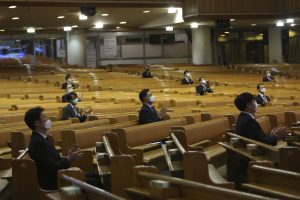 What constitutes a large gathering? According to a report in TheEdgeMarkets it is anything above 250 people (13 March 2020). However, according to theStar online it is anything above 50 people (4 April 2020). On top of this the authorities may still require people to keep a distance of at least one metre (maybe even two metres) from one another. If this is implemented the capacity of a church’s worship hall will immediately be reduced to hold at most one third of the usual crowd at any one time.
 Clearly, church is not just about the worship service. Church ultimately is about relationships (vertical and horizontal), discipleship (or discipling) and reaching out to the world (to win the spiritually lost and to impact our world). If worship services are cut shorter to cater for multiple services and the live-stream “audience”, coupled with social distancing and quick exits from the church building, the worship services are not going to cut it as far as the above mentioned objectives are concerned.
 In the context of Jeremiah 29:13, obviously seeking God is not simply about hearing what the Lord has to say—they had just heard from Him. Seeking God in this case was about the exiles aligning themselves to Him and His purpose. It is one thing to know what the Lord wants—it is another thing to align ourselves to what He says.
 As I spoke, I said to the church, “I don’t know what your expectations are. But, then again, maybe I do. In a crowd like this the expectations are many and varied. You may have gone along on the same journey, but perceptions are different, interpretation of events are different, internalisation of the experiences are different. And depending on what you feel is important you will also expect those things to be addressed as quickly as possible. They are all valid and good. We are all good Christians who want no less than the good of the church. But good must give way to…?”

 “Moving counterclockwise we find the expressive administrator whose heavy sentiment and empathy make him a feeling personality. He speaks quickly and easily to and about people, generally wants his opinions to be accepted, and appears generally impulsive, approachable, and warm. His major abilities lie in teaching, persuading, arousing enthusiasm, and communicating new ideas.