Ugh! The Movement Control Order (MCO) has been extended for another two weeks till 28 April. Even for an introvert like me it’s getting a bit too much of time alone! But that’s not the point of this blogpost.
Even when the MCO is finally lifted there is a real possibility that Putrajaya may ban large gatherings for the rest of 2020.
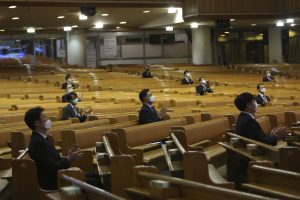 What constitutes a large gathering? According to a report in TheEdgeMarkets it is anything above 250 people (13 March 2020). However, according to theStar online it is anything above 50 people (4 April 2020). On top of this the authorities may still require people to keep a distance of at least one metre (maybe even two metres) from one another. If this is implemented the capacity of a church’s worship hall will immediately be reduced to hold at most one third of the usual crowd at any one time.
I believe churches will want to abide by the directives, and also to keep their members safe. What can we do to adjust to the situation, and yet thrive in it? Here are some suggestions for the worship service.1
- Have multiple services.
- Provide overflow rooms with close-circuit TV or live-streaming facilities.
- Live stream the service so that members2 can join the service at home. Those who prefer to play it safe can stay home and join the service online. Perhaps, it ought to be made mandatory for the less healthy and elderly.
- Members to take turns to attend a live worship. One suggestion is for people to pre-register until the quota is filled, with preference given to those who do not have the technical resources to join the live-stream.
An alternative is to schedule attendance at the live worship by cell groups. What about those who are not in a cell? It then depends on a church’s philosophy of ministry. Either some places are set aside for those who are not in a cell, or they be asked to join a cell as a pre-step to attend a live worship.
The implications of “no large gatherings” is going to be huge on the church. I’ve not begun to address two other important groups, the youth and the children (maybe in another post). And also about outreach—how will we be doing it in the day of social distancing? Here’s the bottom line: I don’t think we can do church in the same way as we did pre-MCO.
 Clearly, church is not just about the worship service. Church ultimately is about relationships (vertical and horizontal), discipleship (or discipling) and reaching out to the world (to win the spiritually lost and to impact our world). If worship services are cut shorter to cater for multiple services and the live-stream “audience”, coupled with social distancing and quick exits from the church building, the worship services are not going to cut it as far as the above mentioned objectives are concerned.
A couple of pastors shared with me that this is where the small group ministry is critically important. Small groups can fulfil all the three objectives. We used to think that the establishment of cells was in preparation for persecution. Little did we know that they would also be critical for a time like this.
I want, however, to add that these small groups must be intentional about discipling, if the church wants to thrive, and not to simply ride out this period of uncertainty. A critical factor rests on a very important person—the small group leader. The above-mentioned pastors said that helping their small group leaders to recalibrate and to empower them for their role will be their primary focus. I’m sure one of the areas of training will be about making effective use of online facilities to connect and disciple their members.
So, during the ban on large gatherings there are at least two things your church should do. One, restructure your worship service and make use of the online platform. And two, recalibrate and strengthen your small group ministry with the focus on caring, discipling and reaching out to others.
1 These include suggestions from the pastors who responded to my query.
2 By “members” I do not mean registered members but all who worship regularly at your church.
Lim Soon Hock Empowering Churches

 In the context of Jeremiah 29:13, obviously seeking God is not simply about hearing what the Lord has to say—they had just heard from Him. Seeking God in this case was about the exiles aligning themselves to Him and His purpose. It is one thing to know what the Lord wants—it is another thing to align ourselves to what He says.
 As I spoke, I said to the church, “I don’t know what your expectations are. But, then again, maybe I do. In a crowd like this the expectations are many and varied. You may have gone along on the same journey, but perceptions are different, interpretation of events are different, internalisation of the experiences are different. And depending on what you feel is important you will also expect those things to be addressed as quickly as possible. They are all valid and good. We are all good Christians who want no less than the good of the church. But good must give way to…?”

 “Moving counterclockwise we find the expressive administrator whose heavy sentiment and empathy make him a feeling personality. He speaks quickly and easily to and about people, generally wants his opinions to be accepted, and appears generally impulsive, approachable, and warm. His major abilities lie in teaching, persuading, arousing enthusiasm, and communicating new ideas.
 This may include planning, but the retreat is more than just about planning programmes for the coming year. It is more about the big-picture; where the church is at, where it is going and what needs to be done to get there. It involves looking at everything and anything that will help the pastoral team accomplish that. I will simply call it Envisioning.
  All pastoral staff are usually given a specific ministry for which he (or she) is personally responsible. While he may be the man in-charge of that ministry he is not, however, to function in a silo. It is very unfortunate that the latter is a common problem in many churches. This is true of both paid staff and unpaid volunteers. Too many church workers are focussed only on their ministry, they fight for the church’s resources for their ministry, they even pray just for their ministry—oblivious of the bigger picture.
 The ultimate purpose of building team spirit among a group of colleagues is to enable them to work together effectively. Hence, it isn’t enough just to have social camaraderie over a cup of coffee or to bond during team building exercises. As the saying goes, “The proof of the pudding is in the eating,”—so, the test of the team is during those times when the team members work together.