Re-Envisioning Vocational Christian Ministry in the Church in Malaysia in Light of Change (Part 2)

by Lim Soon Hock, Empowering Churches

This paper was written in November 2020 when the government of Malaysia imposed restrictive curbs, SOPs, and lockdowns to prevent the spread of the coronavirus (Covid-19). This significantly affected the activities of the church.
Click here for Part 1

A DESCRIPTION OF THE VOCATIONAL MINISTER IN THE MALAYSIAN CHURCH

Hovorun’s point about self-awareness is also applicable for the vocational minister.  The vocational minister needs to be aware of his person, role and functions as a minister in the church.  Self-awareness allows for self-evaluation and self-correction.

In the Malaysian church the general perception is that the role of the vocational minister is to carry out pastoral functions and to meet the pastoral needs of the members of the church.  A simple example is the expectation of members for the main pastor to visit them in hospital and pray for them.  It is not enough that another pastor or a lay-leader visits and prays for them—it must be the main pastor.  The unfortunate result arising from the institutionalism of the church is the perception and expectation that the work of the pastor is to keep the church serviced.

The minister by nature of his role has many functions.  Seward Hiltner in Ferment in the Ministry lists at least nine important functions: preaching, administering, teaching, shepherding, evangelising, celebrating, reconciling, theologising and discipline.1  With so many and varied ministerial functions what should be the overarching function of the minister if he were to make sense and prioritise his varied functions?

The New Testament Image of the Vocational Minister

The NT word for the pastor is poimēn which means shepherd.2  The term is mostly applied to Jesus (Jn 10:11, 14, 16, Heb 13:20, 1 Pet 2:25, Rev 7:17) and once to describe one of the four kinds of men that the Lord gifts to the church (Eph 4:11).  Cognates of poimēn in the NT include poimainō,3 poimnē,4 and poimnion.5  They are used literally for vocational shepherds and their work of tending their sheep, and also figuratively of Jesus and church leaders and their work of ministry among the people under their care. The use of poimēn and its cognates makes the shepherd imagery an apt description for the minister.

The shepherd imagery, with cues from Psalm 23:1-4, sums up the primary role of the minister as leading, feeding and caring for the people in the church.  Leading includes leading the people to the Lord, to grow in their relationship with Jesus and to learn faith and dependence on Him (Gal 4:19).  It also means leading the church collectively towards the purpose of God (Acts 13:1-3, 15:1-35).  Feeding includes teaching the people the Word of God; its truth and application in their lives.  It also involves training them to be effective disciples and workers in the Kingdom of God (Eph 4:11-13, 2 Tim 2:2).  Caring includes spiritual nurturing, binding up the wounds of the soul through counselling and prayer (Js 5:13-16) and protecting the flock from false teaching (Acts 20:28-35).

The Role of the Vocational Minister in the Malaysian Church

As we return to the description of the vocational minister in the Malaysian church, it is clear that among the three functions of leading, feeding and caring, the caring function is the one most expected of the minister.  The least expected is the leading function, and especially in relation to directing the church towards God’s purpose for the church.  I will pick up on this point in the subsequent section of the paper.  The feeding function lies  between the above two functions in terms of what is expected of the minister.

The church in general may recognise the importance of the minister’s role in feeding the flock with the Word of God but in reality they do not place the minister’s teaching function as important as caring for their needs.  I have observed that many churches do not adequately provide the minister with time and resources to empower him to be an apt teacher of the Word.  Neither do they make the minister’s teaching function his primary role in the church.

Chow Lien Hwa’s article in the SEA Journal of Theology calls for a minister to be a theologian in his church.  It is important because, as Chow says, the minister-theologian has the ability to contextualise theology for his area.6  Sunny Tan Boon Sang echoes the sentiment in a review of Chow’s article, “A resident pastor-theologian would be one who could devote himself/herself to the ongoing task of facilitating and supervising the work of theology in a local church.”7  This reminder is even more critical in the context of change because the ability of the minister to determine and lead a right response to the challenge of change requires sound understanding and teaching from Scripture (2 Tim 2:15).

Go to Part 3

Church Strategic Planning Literature Review (Part 3)

(Click here for Part 1 & here for Part 2)

THE CONGREGATIONAL-CULTURE STRATEGY

The quote, “Culture eats strategy for breakfast” has been attributed to management guru Peter Drucker.8  The statement implies that the culture of an organisation determines its success regardless of how effective its strategy may be.9  Hence, nurturing a healthy corporate culture that everyone buys into is critical to the success of the organisation.  In view of the foregoing statements it may appear that the term “congregational-culture strategy” is self-contradictory.  I am referring to the need for a church to attend to its congregational culture as a strategic means for its health.

Aubrey Malphurs, in his book Look Before You Lead: How to Discern & Shape Your Church Culture, defines a church’s congregational culture as “its unique expression of its shared values and beliefs.10  That means, one, a church’s congregational culture is made up of three components: its beliefs, values and behaviour.11  Two, these beliefs and values are held in common by the majority in the church.12  Three, these shared beliefs and values are seen in the expressions or behaviour of the people in the church which gives the church its unique identity13 vis-à-vis another church that, for the same reason, has its own distinct congregational culture.

Malphurs use of the term “beliefs” is not about a church’s doctrinal position but as it concerns the fundamental aspects of the church’s congregational life.14  These beliefs are convictions that the people in the church assume to be true and they are not subject to rational proof.15  It is from the root of its beliefs that a church’s values are formed.16  The values tell us why a church does what it does.17  However, they only become actual values when they are acted on.  Those values that are not acted on remain merely as aspirational values.18  When the values are acted on they are seen in the behaviour of the people in the church, which becomes the outward or visible evidence of its congregational culture.

If the culture of a church is vital to the success of the church, it is inevitable then, that conscious effort is taken to shape the church’s culture so that it produces a healthy church.  Malphurs states that the person that has the greatest responsibility to shape a church’s culture is the pastor.19  It is by no means an easy task, because shaping congregational culture requires change.  Malphurs explains the preparation, personnel and process required to shape the culture of a church.20  Preparation includes praying for change, doing a church analysis, reading the church’s culture, and managing change.21  Process includes reading the church’s current culture, thawing out the current culture, transitioning the culture to a new level, and re-forming the new culture at the new level.22  Personnel is about the kind of person the pastor ought to be if he is to successfully steer the church to a culture change.

Malphurs other book Advanced Strategic Planning: A New Model for Church and Ministry Leaders23 is a useful companion to Look Before Your Lead.  Although the former was written before the latter, the right order to read the books would be the latter before the former.  Look Before You Lead provides the big picture about the necessity to shape congregational culture for church health and the steps that a pastor or church leaders may take to bring about the needed change.  Advanced Strategic Planning goes into the nuts and bolts about developing a church’s core values, mission and vision statements, and ministry strategy.

The importance of shaping congregational culture as a strategic means for developing healthy churches is found in Malphurs’ statement, “we’ve discovered that it’s a waste of time and money to attempt to lead a culturally toxic church that clings to the traditions of men rather than the clear teaching of Scripture through the strategic-envisioning process.”24  In light of this statement, shaping congregational culture is an indispensable requirement to develop healthy churches.  One of the research questions in Matthew C. McCraw’s dissertation made this inquiry, “Of the local churches that possesses a healthy organizational culture what steps were taken to intentionally create culture?”25  His research conclusion from the case studies “revealed the steps that each (church) took to create a healthy culture in their congregations.”26  In other words, shaping congregational culture has to be intentional and definite steps must be taken towards accomplishing that intentionality.


CONCLUSION

As I stated in the introduction, the three categories of strategic planning towards church health, namely Characteristic-Development, Process-Driven and Congregational-Culture are not mutually exclusive.  For example, the use of NCD principles or PDC model is not simply about establishing church health via the development of the critical characteristics of a healthy church or moving people through a process of discipleship respectively.  For the ethos of NCD or PDC to work effectively the churches that use these strategies need to have a congregational culture that upholds these philosophies of ministry respectively.  Hence, determining what ought to be the desired congregational culture and shaping it to become that which is desired must be the starting point for any strategic plan to develop a healthy church.

All three strategies are useful.  They are to be used at different phases of change and improvement of a church’s health because they are targeted at different levels of a church’s corporate life.  The congregational-culture strategy helps set the foundation for what the pastor and church leaders believe should be the overarching ethos of the church.  The process-driven strategy helps to establish a church-wide process that the church leadership believe will move its people, to use Rick Warren’s term, from community to core.27  Finally, the characteristic-development strategy helps church leaders to target attention on specific areas of church life and ministry.  When all three strategies are used in concert with one another it will serve to significantly improve the health of the church.

by Lim Soon Hock, Empowering Churches

Church Strategic Planning Literature Review (Part 2)

(Click here for Part 1)

THE PROCESS-DRIVEN STRATEGY

A clear representative of the process-driven strategy for church health is Rick Warren’s Purpose Driven Church (PDC) model.13  Advocates of a process-driven strategy may or may not have a list of quality characteristics like NCD’s.  In the case of PDC, the five purposes of growing warmer through fellowship, deeper through discipleship, stronger through worship, broader through ministry, and larger through evangelism18 may be seen as PDC’s list of quality characteristics.  In the PDC model, church growth is the natural result of church health.  The latter can only happen when the church’s message is biblical and its mission is balanced.  That is to say, the five New Testament purposes of the church must be in equilibrium with one another.29  It uses the picture of the baseball diamond as a visual to help members of a church see the process (and progress) of their spiritual growth.  Each base represents a level of development.  The objective of the process is to move people from membership to maturity to ministry and finally to missions.30  This may also be viewed through another diagrammatic visual called the “5 Circles of Commitment.”31  It shows the clear intention of the church to move people from “community” (the unchurched) to “crowd” (the attendees) to “congregation” (the members) to “committed” (the maturing members) and finally to become part of the “core” (the lay ministers).32  Warren writes, “Our ultimate goal at Saddleback is to turn an audience into an army.”33  Clearly they have a strategy to accomplish this, namely, the “Life Development Process.”  Saddleback’s success is well documented, having baptised their 50,000th person in its 38th year in 2018.34

A more generic presentation of the process-driven strategy to church health is found in Thom S. Rainer and Eric Geiger’s Simple Church: Returning to God’s Process for Making Disciples.35 The authors define a simple church as “a congregation designed around a straight forward and strategic process that moves people through the stages of spiritual growth.”36  The definition is further expanded and includes four key elements.  In the Simple Church strategic process “The leadership and the church are clear about the process (clarity) and are committed to executing it.  The process flows logically (movement) and is implemented in each area of the church (alignment).  The church abandons everything that is not in the process (focus).”37

The genius of the Simple Church is its simplicity and the clarity with which the authors explain the needful strategic process to make disciples and hence, a healthy church.38  Much of the book is about the four elements.  “Clarity is the ability of the process to be communicated and understood by the people.”39  It is a given that when people have a clear understanding about what something is about, they will be more committed to it.  “Movement is the sequential steps in the process that cause people to move to greater areas of commitment.40  For people to grow spiritually they need to move along in their journey of discipleship, and the church helps by providing them with a process to do so.  In other words, a process helps members of the church to progress.
“Alignment is the arrangement of all ministries and staff around the same simple process.41  Rainer and Geiger maintain that churches naturally drift away from alignment.42  The result of misalignment in purpose, ethos and strategies is that everyone will be doing their own thing as they compete with each other for the same resources which leads to disunity and the church being pulled in different directions.  Alignment means that the ministry-departments must submit and attach themselves to the same overarching process.43  “Focus is the commitment to abandon everything that falls outside of the simply ministry process.44  Focus is knowing what to say Yes to, that is those things that are in alignment to the goals of the church, and the courage to say No to those things that are not in alignment.

Many churches have a desire to make disciples as per the Great Commission, but very few have a process to do that.  The authors of the Simple Church make an important call for every church to have a process in place to make disciples.  An effective process will determine progress.

(Click here for Part 3)

by Lim Soon Hock, Empowering Churches

Church Strategic Planning Literature Review (Part 1)

by Lim Soon Hock, Empowering Churches

INTRODUCTION

A discussion on church health cannot stop at the descriptive level of what a church should be and should do.  The discussion must include how the church is to strategically plan towards health and growth.  The health of a church may be described as the church’s condition when viewed against the New Testament teaching about the Church of Jesus Christ, including its effectiveness in fulfilling the Great Commission (Mt 28:19-20) and the Great Commandment (Mt 22:37-40).  The growth of a church refers to both its quantitative and qualitative growth which are observable and measurable.  Strategic planning in the context of a church may be defined as a systematic process of envisioning a desired future that is aligned with the Bible and translating this vision into broadly defined goals or objectives and a sequence of steps to achieve them.36

Apart from the obvious that a church’s vision must be aligned with the Bible, there are four other key elements in the above definition about strategic planning that we must note.  One, strategic planning begins with the church’s desired end or vision and works backward to its current status.  In other words, to quote Steven Covey’s third habit in the 7 Habits of Highly Effective People, we “begin with the end in mind.”43  Two, strategic planning deals with the broader picture, the church’s vision, and is flexible about the methods to reach it.  Three, strategic planning calls for the development of an intentional plan to achieve the defined goals that lead to the realisation of the church’s vision.  And four, strategic planning requires a process.
The purpose of this paper is to review significant literature about church strategic planning that is focussed on the health of the church.  The literature is reviewed under the following categories that I have termed as: Characteristic-Development, Process-Driven and Congregational-Culture strategies.45  The teaching and practises of these approaches are not mutually exclusive of each other as they overlap at some points.  However, their respective emphasis is also evident.  These will be highlighted and discussed as I review the publications.


THE CHARACTERISTIC-DEVELOPMENT STRATEGY

The study and practise of church health may be approached from a few angles.  One of them may be termed as the “Principle approach.”46  The principal proponents include Christian A. Schwarz and Stephen A. Macchia.47  They have a list of quality characteristics which they deem to be essential to the health of churches in general.  Schwarz’s Natural Church Development (NCD) eight quality characteristics are: empowering leadership, gift-oriented ministry, passionate spirituality, functional structures, inspiring worship service, holistic small groups, need-oriented evangelism, and loving relationships.48  Macchia’s ten characteristics are: God’s empowering presence, God-exalting worship, spiritual disciplines, learning and growing in community, a commitment to loving and caring relationships, servant-leadership development, an outward focus, wise administration and accountability, networking with the body of Christ, and stewardship and generosity.49  Their lists are not identical, but their approach to church health is similar.  They believe that a church must be strong, by maintaining high quality levels, in all the essential characteristics of a church.

A characteristic-development strategy typically begins with an analysis of the health of the church.  This is done with the use of a church health analysis tool that includes a questionnaire survey.  Schwarz’s NCD has a 91-question Natural Church Development Survey50 and Macchia’s Leadership Transformation Inc. has a 72-question Church Health Assessment Tool (CHAT)51 that churches are encouraged to use to evaluate their health.  The completed questionnaires are submitted to NCD or CHAT for a computer generated report that gives a snapshot of the church’s present health.  Included in the report are recommendations that the church leadership team may take to develop greater health for their church.

It appears that NCD is the only church health specialist that gives a definite strategy, beyond providing churches a tool to conduct a church health analysis.  Its strategy is based on one of NCD’s key tenets called “the minimum factor” which theorises that the growth of a church cannot rise beyond the level of its lowest quality characteristic.  Hence, the prime strategy is for the church to give the greatest attention to its lowest quality characteristic.52

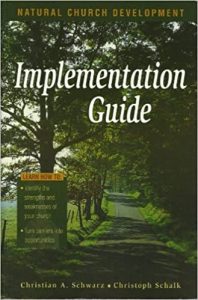
What does a church actually do to improve on the quality of its health characteristics, and in particular for its lowest characteristic?  NCD is one of the few church health specialists that has a whole workbook produced for this purpose, the Implementation Guide to Natural Church Development.53  Included in the book is a section detailing “ten action steps” and another section on “how to improve your minimum factor” for each of the quality characteristics.

The strategic process, such as the one advocated by NCD, of analysing, reporting, recommending (solutions) and implementing (the steps), with a follow-up evaluation, is critical for all churches that desire to develop church health.  However, addressing the “minimum factor” may not necessarily be the primary issue that a church needs to focus on.  Sometimes the “minimum factor” is simply a symptom of a deeper issue or it may have at its source another primary issue that requires greater attention.

(Click here to go to Part 2)

Church Culture in a Pandemic

by Lim Soon Hock, Empowering Churches

After 30 years as a pastor I came to realise (I’m a slow learner) that one of the most important ingredients differentiating poor, good and great churches is church culture. Does a church have the right kind of culture for it to be a good or great church?

The unexpected disruption caused by the Covid-19 pandemic has made the issue of church culture even more important.

For one, the cohesiveness of the church is very much put to the test because in-person meetings have been curtailed. This is especially disruptive for corporate worship, which is traditionally the main church event.

As I write this, Malaysia is reeling from a third wave of the virus, and much of the country was again under a Movement Control Order for the last two months. Churches have resorted to the use of online technology.

Will a church survive—nay, thrive in the pandemic? I believe the answer depends very much on its culture.

A Crisis Shows Up a Church’s Real Culture

Aubrey Malphurs, in his book Look Before You Lead: How to Discern & Shape Your Church Culture, defines a church’s congregational culture as “its unique expression of its shared values and beliefs”(p20). That is, a church’s congregational culture is made up of three components: its beliefs, values and behaviour. When beliefs and values are held in common by the majority in the church and are then actually seen in the people’s behaviour, they become culture—they give expression to the church’s unique identity.

It is this congregational culture that determines whether a church simply survives or thrives in this present challenge. Unsurprisingly, it is in a time of crisis that the real culture of a congregation becomes clearly evident. For example, is there a real culture of commitment, sacrifice, faithfulness and the like in the church? Or, were they just aspirational values? Or, worse yet, were they simply wishful thinking?

In particular, does the church have a culture where every member is connected, committed and participating in a small group? At a time when large gatherings are curtailed, small groups are the best vehicles for fellowship, discipleship and even outreach. This may be done online, in-person or in a hybrid form.

It is never too late to start a small group ministry or to encourage members to get into one. However, it is much more advantageous if small groups were already part and parcel of the culture of the church. The difference between the two is like an athlete fumbling to put on his running shoes when the starting pistol goes off and an athlete who already has his shoes on.

The Roles of the Pastor and Consultant in Shaping Church Culture

If the culture of a church is vital to the success of the church, it is inevitable that conscious effort is taken to shape the church’s culture so that it produces a healthy church. Malphurs states that the person that has the greatest responsibility to shape a church’s culture is the pastor (p129). It is by no means an easy task, because shaping congregational culture requires change. Malphurs explains that preparation, personnel and process are required to shape the culture of a church (p10-12).

I believe that church consultants have a role to play to help pastors and church leaders understand the importance of church culture. They can act as the leaders’ sounding board as the latter pursue a conscious effort to shape their congregational culture. Moreover, church consultants can study and analyse the real culture of the church (which the leaders may have blind spots), and suggest ways to develop the church’s unique and desired congregational culture that is Scripture-faithful, healthy and life-giving.

The importance of shaping congregational culture as a strategic means for developing healthy churches is found in Malphurs’ statement, “we’ve discovered that it’s a waste of time and money to attempt to lead a culturally toxic church that clings to the traditions of men rather than the clear teaching of Scripture through the strategic-envisioning process,” (p17). Hence, I believe that shaping congregational culture is an indispensable requirement to develop healthy churches.

Reference: Mulphurs, Aubrey. Look Before You Lead: How to Discern & Shape Your Church Culture. Grand Rapids, MI: Baker Books, 2013

This article was first written for the the Society for Church Consulting blog posts on 15 December 2020. You may access it here.


Church Health Literature Review (Part 3)

(Click here for Part 1 and here for Part 2)

THE ORGANIC-MISSIONAL APPROACH TO CHURCH HEALTH

With reference to the last point above, indeed one of the criticisms levelled against church health teaching, especially the principle approach, is that it is too much focussed on the church body.  Charles Van Eggen remarks that seven out of NCD’s eight quality characteristics, the possible exception being “need-oriented evangelism”, are concerned almost exclusively with the internal life of the church.54  Ed Stetzer, who propounds a missional matrix of christology, ecclesiology and missiology, comments that the Church Health Movement focuses largely on ecclesiology in order to grow.  Hence, Stetzer argues, “by emphasizing ecclesiology, with a limited Christology and an absent missiology, the Church Health Movement stepped outside of the scriptural and theological foundation leading to blindness to the world outside the church walls.”55  That is to say, if missions or the Great Commission is not the focus and pursuit of the church the latter cannot be deemed to be healthy.

This is where the organic-missional approach to church health needs to be seriously considered.  The primary proponent of this approach is Neil Cole who wrote Organic Church: Growing Faith Where Life Happens.56  The purpose of “organic churches” is to multiply healthy disciples, leaders, churches and movements,57 and this multiplication can happen anywhere and everywhere.58  They endeavour to accomplish their purpose by emphasising on the health and the natural means of reproducing the foregoing.[end_notes]Ibid, 23[/efn_note]  Cole argues for the organic nature of the Kingdom of God.59  He uses the agricultural-setting parables of Jesus as his Scriptural basis for organic churches: the sower60 (Mk 4:3-20), the growing seed61 (Mk 4:26-29), and the mustard seed[end_note]Ibid, 97-98[/efn_note] (Mk 4:30-32).

As far as the organic nature of the church is concerned Schwarz and Cole are in agreement.  How they apply that biblical truth, however, differ.  Schwarz would say that we need to produce a healthy environment for the church to grow.62  Cole would say we need to produce the right DNA at every level: the individual disciple, small groups, church and movement so that growth and reproduction take place.63

The stress on the organic nature of the church may at first appear to be the overriding characteristic in Cole’s idea of the church because of the name given to it, namely “the organic church”.  However, the missional aspect of his idea of church cannot be glossed over as secondary.  Missions is at the very heart or thrust of the organic church.64  Indeed his understanding of the DNA of the church is made up of Divine truth, Nurturing relationships and Apostolic mission.65  This DNA may also be seen as Cole’s short list of characteristics of a healthy church, and missions is not only one of three critical components it is also the outward thrust for the church.

Colin Marshall and Tony Payne’s The Trellis And The Vine: The Ministry Mind-Shift That Changes Everything66 has similarities with Cole’s Organic Church.  The trellis refers to the structures and programmes that support the ministry of the church.  The vine essentially refers to the people who are part of the Body of Christ or who will eventually be incorporated into His Body.  Marshall and Payne write, “This is what the growing of the vine really is: it is individual, born-again believers, grafted into Christ by his word and Spirit, and drawn into mutually edifying fellowship with one another.”67  In essence The Trellis and the Vine is the authors’ argument for the church to make paramount disciple-making.  “Church health” is not a term they use, but it would be right to say that in their view when a church gives attention to the vine work of making disciples the church will be healthy.  Their follow up book The Vine Project: Shaping Your Ministry Culture Around Disciple Making68 provides a detailed roadmap for churches who wish to embark on this journey.  The two key things that such churches must do is one, to develop a culture of making disciples69 and two, multiplying gospel growth through training co-workers.70

It seems odd that while the title of the book is The Trellis and the Vine, nothing significant is said about the trellis.  When the trellis is mentioned it is written with a negative view—that churches have allowed structures, programmes, polity, management and the like to stifle disciple-making.71

Cole’s Organic Church has a better balance, to use Marshall’s and Payne’s imagery, of the trellis and the vine.  Cole writes, “Structures are needed, but they must be simple, reproducible, and internal rather than external.”72  He goes on to draw an imagery from the exoskeleton and endoskeleton of the human body.  He writes, “The structure should not be seen, yet the results of it should be evident throughout the body.  Organization must be secondary to life and must exist to help support the organic life of the body.”73  The church as a living spiritual organism must inevitably be organised.  However, the structures must not dominate the church’s missional purpose of making disciples but to serve it. 

CONCLUSION

Each individual approach to church health, principle, biblical and organic-missional, is insufficient to provide us with a comprehensive study and understanding of church health.  The three approaches should be woven together if we are to have a better grasp about what constitutes a healthy church and how we are to measure it.  The student of church health must begin by studying what the Bible says about the church—what it is and what it is to do, as the advocates of the biblical approach would counsel us.  What the Bible says must form the foundation for any definition and set of characteristics of a healthy church.

However, simply knowing what the Bible says about the church is, by itself, insufficient to determine the health of a church.  The latter needs to be analysed, and the process of analysis should include the use of social science research tools. This is one aspect that the principle approach to church health has to offer.  To be certain, the areas to be “measured” are not simply from an organisational aspect, collections and attendance at worship services.  What the Bible says about the life and calling of the church must be our guide.  In this sense the commitment and effectiveness of a church to its missional calling and the Lord’s commission to make disciples, that the organic-missional approach stresses, must play a prominent part in the assessment of the health of a church.

by Lim Soon Hock, Empowering Churches

Church Health Literature Review (Part 2)

(Click here for Part 1)

THE THOLOGICAL APPROACH TO CHURCH HEALTH

The advocates of the theological approach to church health primarily look at what the Bible says about the church—what the church is to be and to do.  One of the most significant contributions to church health literature in this vein is Mark Dever’s Nine Marks of a Healthy Church.57  He disagrees with the focus on pragmatism and numerical church growth of popular models of church.74  He also disagrees that appearances of relevance and outward responses are key indicators of being a successful church.75  Instead he opines, “We need churches in which the key indicator of success is not evident results but by persevering biblical faithfulness.”76

The first five of Dever’s nine marks of a healthy church concern the right preaching of the Word of God: (1) expositional preaching, (2) biblical theology, (3) the gospel, (4) biblical understanding of conversion, and (5) biblical understanding of evangelism.  The last four marks concern discipleship: (6) biblical understanding of church membership, (7) biblical understanding of church discipline, (8) Christian discipleship and growth, and (9) biblical understanding of church leadership.77  Dever admits that these are not the only marks of a healthy church and may not even be the most important.78  What’s critically important is that the teaching on these aspects of church health are derived from Scripture itself, hence the qualifying word “biblical” accompanying most of the marks.

Dever states that the first mark, expositional preaching is the most important, which in his mind is the only form of biblical preaching.79  By expositional preaching he means preaching a message from a passage of Scripture in its context.80  In other words, the text determines the point rather than the text being used to support a pre-conceived point.  A healthy church is one whose beliefs and practices are derived from the Bible, such as Dever’s nine marks themselves.

Most of Dever’s nine marks of a healthy church fall under the category of spiritual health.  They are also described primarily from a spiritual angle.  While the church is a spiritual entity, a comprehensive understanding and evaluation of the health of a church must, nonetheless, include its organisational health.  The latter comprise the structures, systems and processes by which a church uses to develop the marks of a healthy church.  A biblical- or theological-only approach to the study of church health does not appear to address the church’s organisational health.

John Stott’s The Living Church: Convictions of a Lifelong Pastor81 would fall into the category of a theological approach to church health.  The purpose of Stott’s book is to set out the theological and essential marks that characterise an authentic and living church.82  It is obvious that Stott does not mean to stipulate an exhaustive list of such characteristics.  From Acts 2:42-47 he determines that there are four essentials in the kind of church that God envisions: (1) a learning church, (2) a caring church, (3) a worshipping church, and (4) an evangelising church.83  In the remaining chapters of the book he discusses different aspects of church life.  Some are directly related to the four essentials mentioned above, others do not have any connection to the four essentials; such as ministry, giving, and impacting our world for social change.

His concluding chapter on “Looking for Timothys” is not really a conclusion.  It could even be seen as another mark of a healthy church—the need to look out and raise up Timothys.  As with Nine Marks, The Living Church is necessary and helpful in the study of healthy churches because it presents the biblical teaching on what Stott deems to be the marks of a healthy church.  His gleanings from Scripture regarding these marks are insightful.

In a slight departure from an otherwise theological-only approach to church health, Stott encourages surveys to be done of the community and the church to determine if a church has organised itself relevantly to the community, or is there a disconnect between them?84  Surveys or studies such as these are critical since the level of effective community outreach is an important component to determine the overall health of a church.

(Click to go to Part 3)

by Lim Soon Hock, Empowering Churches

Church Health Literature Review (Part 1)

by Lim Soon Hock, Empowering Churches

INTRODUCTION

The subject of church health is less precise than the subject of church growth.  Unlike the latter the former does not have the coherence of the Church Growth Movement (CGM) nor does it have formidable spokesmen that Donald McGavran and Peter Wagner had been for the latter.  As a result, each advocate of church health has his own definition and set of characteristics for what constitutes church health.

The purpose of this review of church health literature is to scope from among the significant authors on this subject for their understanding and criteria of church health.  These views of church health may be classified under three broad categories: The Principle, the Biblical, and the Organic-Missional approaches.79 This is not to say that the principle approach is unbiblical or non-missional.  It is.  However, its emphasis is on the principles of church health.  The same can be said of the other two approaches that make much of their own emphasis.

In this article I will review two significant publications that represent each of these approaches.  Due to the limitation on the length of the article, the second book in each approach is given less treatment than the first book.  I conclude this review of church health literature with a discussion on how all three approaches together may help toward a greater understanding of church health.


THE PRINCIPLE APPROACH TO CHURCH HEALTH

The principle approach looks at what constitutes church health characteristics from both Scripture and practice of church life and ministry.  Then it looks at how a church is to improve along the quality scale of these characteristics so that it becomes a healthier church.

Christian A. Schwarz is one of the most quoted proponents for this approach on church health.83  His teaching on church health is found in his basic text titled Natural Church Development: A Guide to Eight Essential Qualities of Healthy Churches85 and a later publication called Color Your World with Natural Church Development: Experiencing all that God has designed you to be which was written for Christians to apply NCD principles at the personal level.86  Arising from his extensive research that covered churches around the globe,87 he determined that there are eight quality characteristics that all churches must have.  They are: (1) empowering leadership, (2) gift-oriented ministry, (3) passionate spirituality, (4) functional structures, (5) inspiring worship service, (6) holistic small groups, (7) need-oriented evangelism, and (8) loving relationships.

The health of a church is reflected in the overall quality of these characteristics found in the church.  The health is determined through a quantitative survey done among selected members of the church.88  Furthermore, NCD research reveals that if every quality characteristic scores 65 and above on their rating scale then the church is inevitably a growing church.  This is known as the “65 hypothesis.”89  The point of this approach to church health is for a church to keep improving on the quality of all eight characteristics.  The greatest attention, though, is to be given to the lowest quality characteristic because the growth of the church cannot rise beyond the level of that characteristic.  This is termed the “minimum factor.”90

The strategy also calls for the incorporation of NCD’s six biotic principles: (1) interdependence, (2) multiplication, (3) energy transformation, (4) multi-usage, (5) symbiosis, and (6) functionality. These principles are biotic in nature because a church is an organism and not a machine.91  When these principles are applied they “create an environment that will allow God’s growth automatisms—with which He Himself builds the church.”92  NCD stresses the development of an environment in a church where the church can grow.  In other words, church health naturally93 or automatically94 leads to church growth.  Schwarz terms it “The ‘all-by-itself’ principle”95 found in the parable of the growing seed (Mark 4:26-29).

Another principle approach to church health is found in Stephen A. Macchia’s Becoming a Healthy Church: 10 Characteristics.96  The ten characteristics were determined from a survey done among the Vision New England churches97 where Macchia served as its president from 1989 to 2003.  The study did not only help Macchia and his team to determine the ten characteristics, it also helped them rank the characteristics.  They are: Level 1 – How I relate with God: (1) God’s empowering presence, (2) God-exalting worship, (3) spiritual disciplines.  Level 2 – How I relate with my church family: (4) learning and growing in community, (5) a commitment to loving and caring relationships, (6) servant-leadership development.  Level 3 – How my church ministers and manages: (7) an outward focus, (8) wise administration and accountability, (9) networking with the body of Christ, and (10) stewardship and generosity.98

One of the key concepts for church health advocates is “balance”—a balanced pursuit and presence of all the essential elements or characteristics of a church.  Macchia stresses it.99  Schwarz speaks of the “harmonious interplay of all eight elements.”100  Rick Warren posits that “the five New Testament purpose of the church must be in equilibrium with the others for health to occur.”101  Nelson Searcy who takes a systems-approach to church health states that “The eight systems of every church are interconnected.  While some may be more developed than others, none of these systems can stand alone.”102  Hence, there is a need to ensure that all the systems in the church are functioning properly at a high level and in balance with one another.

Church health proponents have varying opinions as to what constitutes the essential characteristics of church health.  Sometimes it is simply the use of different terminologies or different ways of classification.  Barring this, the principle approach rightly recognises that the quality level of these characteristics in a church determine the overall health of the church.  Since they are all important, a high quality level for every characteristic and balance among them are key to the health of the church.

One of the features of the principle approach is that it is not simply theoretical and descriptive about what a healthy church should look like.  Many of them have developed tools to evaluate the health of the church based on their criteria of church health characteristics.  NCD has its 91-question Natural Church Development Survey.103  Macchia, who went to found Leadership Transformation Inc., developed the Church Health Assessment Tool (CHAT) with 72 questions covering the ten characteristics.104  These objective instruments are necessary to produce quantifiable data and measurable results to accurately assess the health of a church.

(Click to go to Part 2)

Church Growth Literature Review (Part 2)

(Click here for Part 1)

DIVERSIFICATION OF CHURCH GROWTH TEACHING

In 1982 Wagner invited John Wimber to teach the course MC510: Signs, Wonders and Church Growth at Fuller’s School of World Mission.  As a result of Wimber’s influence Wagner’s views on the work of the Holy Spirit, like spiritual gifts, began to shift.  His shift moved even further in the following years through the influence of people like Cindy Jacobs and Chuck Pierce.  While Wagner was still focussed on church growth, he was, however, looking at other factors of church growth that were not under the classical Church Growth radar like spiritual gifts, prayer and spiritual warfare.  In the revised third edition of Understanding Church Growth (1990) (done with the consent of McGavran) Wagner added a whole new chapter on “Divine Healing and Church Growth”.95 

In Church Growth State of the Art (1986) there was a whole section consisting of four chapters on “Church Growth and the Holy Spirit”.97  One chapter was on the supernatural anointing of the Holy Spirit for ministry and another was on the importance of power encounter for church growth.  The latter chapter being a contribution by John Wimber. 

While Wagner’s shift did not in itself precipitate the diversification of church growth teaching, it however, left an open field for new ideas about church growth to be introduced99 by practitioners (pastors) demographers and church consultants.103  Gary McIntosh has drawn a helpful chart showing the various sub-branches of what he calls the “Popular Church Growth prong”: (1) Systems Research, (2) Survey Research, (3) Polling Research and (4) Anecdotal Research (Stories of Growing Churches).105

Many books published during this time were about principles and strategies for numerical church growth.  They were mostly written from the perspective of the church as an organisation (albeit a biblical, living, spiritual organism). 

The following is a  sampling of such publications. Carl F. George’s How to Break Growth Barriers (1993).106  The basic thesis of his book is that if a pastor is to lead his church to growth he needs to move from being a shepherd to that of a rancher.  In other words, instead of being the primary caregiver the pastor needs to develop others to care for the members of church and do the work of ministry.  Gary L. McIntosh’s One Size Doesn’t Fit All (1999).107  He says that the size of a church determines how it “does church” including how it is structured, the role of the pastor, how decisions are made, and the strategies it deploys to overcome obstacles and grow the church. 

From a more business approach George Barna wrote a highly controversial book called Marketing the Church .108  It was about using the marketing tools of the business world to reach out and to win a church’s target group.  McIntosh comments, “This marketing emphasis effectively turned many people away from the popular notion of church growth, and caused a reaction toward a new paradigm of church health in the mid 1990s.”109

Then there were the books that proposed models of what churches ought to be and do so that they may grow and fulfil the Great Commission mandate. Rick Warren’s The Purpose Driven Church (1995)110 was one of the first books that provided a balanced approach (The 5-Purposes) to grow a church.  It detailed a process (The Life Development Process) depicted by the baseball diamond and a plan to move people from Community to Core.  It also incorporated the HUP (although he does not attribute to it) by describing Saddleback’s target group, aka Saddleback Sam and Samantha.  


CONCLUSION

As I draw the review of church growth literature to a conclusion, I return to the three questions I posed at the beginning of the article.  First, is church growth teaching to be defined by and limited to McGavran’s and Wagner’s views during the classical Church Growth period?  Advocates of CGM are adamant that church growth teaching must employ “as its initial frame of reference the foundational work done by Donald McGavran and his colleagues.”113  While I concur with this, I believe it would be limiting the usefulness of Church Growth teaching if it did not allow for additional structures to be built on that foundation.  A case in point would be Wagner’s “discoveries” in the healing-prayer-spiritual warfare factor of church growth.114  He was disappointed that McGavran and others did not see that it was very much a part of and concerned the Church Growth field and agenda.  Church health teaching falls in the same vein (I will pick up this thread again when I answer the third and final question).

The second question I posed was: what are the irreducible principles for church growth?  From the review of church growth literature, I believe they would be:

  1. Quantitative and Qualitative Growth.  Churches commissioned by Jesus in Matthew 28:19-20 must grow both numerically and in spiritual maturity.
  2. Research and Analysis.  Research must be done to learn (a) about the people the church is attempting to reach with the Gospel, (b) the best means to reach this specific group of people, and (c) the hindrances to the growth of the church, and
  3. Strategic Planning.  Determine the best strategies to be deployed based on the research and analysis to accomplish the purpose of the church with the use of planning and programming.115

However, to say that the above three principles of church growth are foundational does not mean that they are exhaustive.  Upon these foundational principles of church growth I believe there should be an openness to allow for other well-tested tenets of church growth to be added to them.  These would include the contributions of specific subjects such as church leadership, spiritual gifts and ministry strategies as they are applied in the church growth context. 

Finally, what influence did church growth teaching have on the later development of church health teaching?  Church health teaching came about as a response to church growth teaching, whether as a correction in relation to some of the misgivings of the latter or as a development of the latter.  The bottom line is that we cannot separate the two.  Church health is a necessary factor for church growth.  The growth of a church, both in quantitative and qualitative terms, is dependent on the health of the church.  I will look further into this as I review church health literature in a subsequent article.

by Lim Soon Hock, Empowering Churches

Church Growth Literature Review (Part 1)

INTRODUCTION

Part of the interest in my research concerns the correlation between a church’s health and its growth, especially in view of the Great Commission (Mt 28:19-20).  This article is a review of literature on the subject of church growth.

The literature review shows two distinct phases in the development of church growth teaching.  The first phase was the classical Church Growth period116 led by its founder Donald A. McGavran and his successor C. Peter Wagner.  McGavran’s publication of The Bridges of God in 1955 birthed the Church Growth Movement (CGM).  The second phase began around 1988 when Wagner moved into other areas of interests.  While his new interests were still in relation to the subject of church growth, they were nonetheless perceived as detours from classical Church Growth teaching.117  When he retired from Fuller Theological Seminary in 2001 it left CGM leaderless and rudderless.  As a result, the teaching on church growth that was already evolving became even more diversified.  Thom S. Rainer’s The Book of Church Growth (1993) provides a very helpful overview of the history and diversification in church growth teaching.118  For a more detailed and personal account of these changes in church growth teaching one may read Wagner’s fascinating memoirs Wrestling with Alligators, Prophets, and Theologians (2010).

While this article is a review of church growth literature it does so with three questions in mind: First, is church growth teaching to be defined by and limited to McGavran’s and Wagner’s views during the classical Church Growth period?  Second, what are the irreducible principles of church growth?  Finally, what influence did church growth teaching have on the later development of church health teaching?


THE CLASSICAL CHURCH GROWTH TEACHING

Innumerable books on CGM teaching were published during the heyday of the movement from the 1970s to the mid-1990s.  The most important books to consider would be those by McGavran as the founder of the movement and Wagner who succeeded him as its leader and chief spokesman.

As previously mentioned the publication of The Bridges of God (1955) birthed the CGM, but it was McGavran’s Understanding Church Growth (1970) that spelt out his mature thinking on the theology, sociology and methodology of Church Growth.119  Wagner said, “Understanding Church Growth is one of those classics which has become the indispensable foundational text for an academic field.  No one can claim to be a serious student of church growth who has not read and absorbed the content of Understanding Church Growth.120

The most persuasive point of McGavran’s book is that God wants lost people found.  The church cannot be content with just searching (Search Theology121) but to win the lost to Christ (Harvest Theology122).  Hence, evangelism is critically important and must have absolute priority over any other activity of the church.  In God’s schema it is His will for the church to grow numerically, for this would mean lost people are found.

In order to accomplish this evangelistic growth to the greatest effect, McGavran posits that the church should invest the greatest amount of its resources to the most (or more) receptive people (Theory of Receptivity123).  The way to determine who the receptive people are and what the best means are to reach them is through research, including the gathering and analysis of statistical data (Social Science Research124).  With the necessary information a church is then able to strategise (for example, by building bridges to receptive people) and to set goals to grow the church (Planning and Goal Setting125).

McGavran’s church growth principles are derived from well researched data of growing and non-growing churches in the mission field such as Ghana, South Korea and India.126  He quotes studies that he or others had done.127  Backed by such serious studies it is hard to ignore the findings, conclusions and principles of Church Growth teaching.

In Church Growth and the Whole Gospel (1981) Wagner writes to elaborate and defend the tenets of CGM.  For example, he defends the priority of the evangelistic mandate vis-à-vis the cultural mandate.128  Another concerns the Homogenous Unit Principle (HUP).  It was not the most important tenet of CGM teaching but it became the most controversial.  McGavran observed that “People like to become Christians without crossing racial, linguistic, or class barriers.”129  Wagner defends the principle by saying that “McGavran’s statement is descriptive, not normative.  It is phenomenological, not theological. …Secondly, McGavran’s statement relates to discipling, not perfecting.  It is a principle of evangelism, not Christian nurture.”130  If HUP is accurate, it then provides the church with a useful key for “effective implementation of the evangelistic mandate.”131

In a later book Strategies for Church Growth (1987) Wagner starts by revisiting some of the basic church growth principles.  He explains how the advocates of CGM understand the terms commonly used in Christian circles.  For example, what does “make disciples” mean?  Wagner says that “The raw material of making disciples in the Great Commission sense is unbelievers who need to commit their lives to Christ for the first time.  The raw material of modern ‘disciple making’ is Christians who need to be helped along the continuing road of Christian discipleship.”132  Hence, he argues, “If we concentrate on church growth, we get to the heart of the Great Commission.  The more we evangelize and the more disciples we make, the more churches will be multiplied and grow.  And this is why, in planning strategies, we aim for church growth.”133

In other words, “making disciples” or winning the lost through evangelism is the goal of church growth and developing and carrying out strategies to accomplish this goal is critical to its success.  We can, therefore, understand why planning strategies is one of the hallmarks of CGM teaching.  Much of the book Strategies for Church Growth focuses on the importance as well as the practical steps to develop these strategies.

Understandably, Church Growth teaching during the classical era was not without its detractors.  I have already mentioned some of the criticisms such as those against the HUP,134 the priority of evangelism, and the emphasis on numerical growth.  Perhaps, the chief criticism against church growth teaching is that it lacked a solid theological foundation.  Despite the attempts of CGM to address this issue, strong criticisms were levelled against Church Growth theology or lack thereof.  This is seen in the strong discussion generated in Evaluating the Church Growth Movement (2004).  For example, Craig Van Gelder charges that establishing church growth principles by simply listing some biblical texts does not mean that theology is done.135  Also, Gailyn Van Rheenen questions whether one should even be doing theology “with Church Growth eyes”.  He contends that biblical theology should form the lens through which cultural and contextual issues and praxis are viewed.136

(Click to go to Part 2)