by Lim Soon Hock
One of the resources that is not tapped by the Malaysian church is the pool of retired pastors. Many of them often end up in an itinerant ministry that’s generally limited to preaching at worship services. Their knowledge and experience of leading and pastoring a church remain largely unutilised. Could they be better engaged? I believe they can—as interim pastors.
Benefits of Engaging a Retired Pastor as an Interim
1. General pastoral ministry. The first and most obvious benefit is that the church has someone who is able to handle much of the ministry that was carried out by the former minister. These include  organising the pulpit programme and preaching; coordinating the ministries of the church; visitation and counselling; and assisting the leaders to lead the church.
2. Specific and intentional ministry. Apart from the traditional pastoral services, the interim may also be tasked to address certain issues affecting the church, such as an unresolved conflict. Perhaps, it was for this precise reason that the former pastor left the church. Understanding, healing, closure, and restoring unity would then be absolutely necessary for the church to move on without being shackled by the trauma.
Another area that an interim might specially be entrusted to do is to implement and manage change in the church, such as reorganising the ministries of the church. Each ministry may be operating in its own silo. As a result, the ministry of the church as a whole has become unwieldly and ineffective. Thus, aligning the ministries to the purpose and vision of the church is necessary to unite the church; and forging the different ministries to work in collaboration with one another is needful to enhance the church’s effectiveness.
The interim’s role in this regard, then, is not simply to keep the church going from Sunday to Sunday—aka, maintenance-ministry. Rather, his role is intentional—to help the church progress during a period of transition. The expected outcome is that the next tenured minister has a healthier church to pastor, and perhaps, one that is poised for greater things.
I am certain that a church will benefit from the ministry of an interim. Conversely, the retired pastor will also benefit from his new role as an interim.
Benefits to a Retired Pastor Engaged in Interim Ministry
1. Sense of purpose. Many pastors become anxious when they approach retirement age, primarily for two reasons. The first has to do with their life-purpose. Being a pastor of a church is a  defining-identity for most pastors, especially if they have been at it for a long time. When a pastor stops being a pastor, he (or she) starts to question the purpose of his life. Even the occasional itinerant preaching ministry will not give him a great deal of fulfilment.
However, if he were engaged as an interim, whether in a full-time or part-time capacity, the service, the ministry, the work, and the new relationships will give him a sense of purpose, usefulness and fulfilment. He is still able to use his gifts, knowledge and experience to serve the Lord and His church. The new role might indeed invigorate him because it’s a little different from his previous responsibility as the pastor of a church.
2. Financial security and dignity. The second reason a pastor might be anxious as he approaches retirement has to do with finances. Most churches in Malaysia don’t provide financial support for their pastors when they retire. How will he support himself? This is a real-world concern (notwithstanding the faithfulness of the Lord to provide for His servant). Living off one’s savings and EPF1 contributions can last only so long. Honorariums from speaking engagements in Malaysian churches are not, generally speaking, generous.
A definite monthly income as an interim will cushion the drastic change in his financial position. A regular income will give him a sense of financial security and dignity.
3. Limited duration of engagement. Further benefits to the interim minister include the limited duration of his commitment to the church. A pastor in his senior years may no longer want to be engaged for an indefinite period of service. A six to 24 months stint to help a church might be ideal. At the end of the engagement he can assess whether he wants to continue in the interim ministry in another church.
4. Limited hours of service. A pastor in his senior years may also not want a full-time job. A part-time engagement as an interim might indeed be ideal for both him and the church. He is able to find purpose for his life and ministry, and at the same time be assured of some financial support. On the other hand, a church may not have the finances to support a full-time interim; and yet if they engage an interim in a part-time capacity they can still benefit from his pastoral maturity and experience.
I believe that empowering the retired-pastor as an interim is a good move in the right direction for the Malaysian church. Regardless of language group or denominational persuasion, pursuing the understanding and practice of the interim ministry will bring great benefits to both the church and the pastor.
(You may want to read a previous article, “Some Churches in Malaysia May Need Interim Pastors.” Click here.)
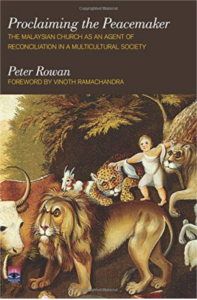 From a survey among Malaysian Christians, the author concludes that while the respondents see peace-building as part of the church’s mission, there is, however, a gap between belief and practice.


 The New Testament is clear about the plurality of leaders. Paul instructed Titus to appoint “elders in every town” in Crete (Tit 1:5). Similarly, on their return leg of their first missionary journey, Barnabas and Paul “appointed elders for them in each church” in the cities of Lystra, Iconium and Antioch (Acts 14:21-23).
 By “all things being equal” I mean that the pastor is just as capable, mature, spiritual, knows his Bible, and has leadership qualities as any of the other leaders in the church. If the pastor isn’t, relative to one or more of the other leaders, then, it is possible that another elder who is more qualified be appointed as the team leader.
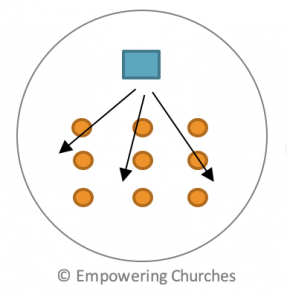 Let me begin by contrasting a teaching situation and a small group discussion. In the classic teaching set-up, the students sit in rows; everyone faces forward and looks at the teacher. They don’t see each other’s faces, only the teacher’s.
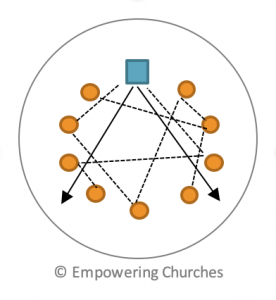 It is not a good idea to have more than one layer of people. No one should be sitting behind another person. Everyone should be able to have eye-contact with every person in the group.
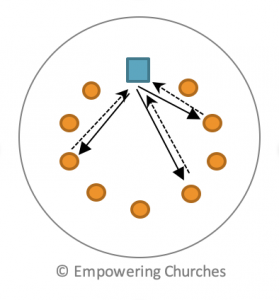 What is important to note is that the lines of communication are not just between the leader and the others, but also between the members of the group. If the conversation were just between the leader and each member, then the dynamics would be a “quiz”. The leader asks a question and someone responds. Then, back to the leader who follows up with a comment and/or another question. The cycle is then repeated. In this case, the leader is not functioning as a facilitator but a quiz master. However, a discussion, by definition, is only assumed to have taken place if members of the group interact with one another. One of the key jobs of the study leader then is to facilitate this interaction between members.
 In this regard, the study leader steers the conversation around the topic. He guides the members to make contributions that are relevant to the focus of the study. If the discussion goes awry, the leader brings it back on track. If the discussion gets stuck, he moves it along. If a member of the group isn’t contributing to the conversation, he encourages him or her to participate. If someone is hogging the conversation, he tactfully gets others to share. At the end of the study, he brings the discussion to a close with a clear conclusion; including a take home point from the study.
 The study leader is often temped to answer his own questions, especially when the group is slow to respond. But he must strongly resist! It wouldn’t be a discussion if the leader were to pose a question only to supply the answer himself. This does not mean that the leader does not come prepared with answers. He does. But he only shares it when it’s necessary to do so or by way of rounding off a segment of the discussion and as a conclusion to the study.
 What is a Predictable Sermon?
 later. That is to say, there is a “wait for it” element in the movement of the sermon. Some teachers of homiletics have called this movement, “tension and resolution.”
 Apart from the Lord’s call, the reason I entered full-time Christian ministry was because I wanted my life to make a difference. Maybe at that point in time I didn’t think of it in that precise term. However, what was true was that my life had been transformed by the Gospel and all I wanted to do with my life was to bring that same transforming message to others.