by Lim Soon Hock, Empowering Churches
INTRODUCTION
A discussion on church health cannot stop at the descriptive level of what a church should be and should do. The discussion must include how the church is to strategically plan towards health and growth. The health of a church may be described as the church’s condition when viewed against the New Testament teaching about the Church of Jesus Christ, including its effectiveness in fulfilling the Great Commission (Mt 28:19-20) and the Great Commandment (Mt 22:37-40). The growth of a church refers to both its quantitative and qualitative growth which are observable and measurable. Strategic planning in the context of a church may be defined as a systematic process of envisioning a desired future that is aligned with the Bible and translating this vision into broadly defined goals or objectives and a sequence of steps to achieve them.1
 Apart from the obvious that a church’s vision must be aligned with the Bible, there are four other key elements in the above definition about strategic planning that we must note. One, strategic planning begins with the church’s desired end or vision and works backward to its current status. In other words, to quote Steven Covey’s third habit in the 7 Habits of Highly Effective People, we “begin with the end in mind.”2 Two, strategic planning deals with the broader picture, the church’s vision, and is flexible about the methods to reach it. Three, strategic planning calls for the development of an intentional plan to achieve the defined goals that lead to the realisation of the church’s vision. And four, strategic planning requires a process.
The purpose of this paper is to review significant literature about church strategic planning that is focussed on the health of the church. The literature is reviewed under the following categories that I have termed as: Characteristic-Development, Process-Driven and Congregational-Culture strategies.3 The teaching and practises of these approaches are not mutually exclusive of each other as they overlap at some points. However, their respective emphasis is also evident. These will be highlighted and discussed as I review the publications.
THE CHARACTERISTIC-DEVELOPMENT STRATEGY
The study and practise of church health may be approached from a few angles. One of them may be termed as the “Principle approach.”4 The principal proponents include Christian A. Schwarz and Stephen A. Macchia.5 They have a list of quality characteristics which they deem to be essential to the health of churches in general. Schwarz’s Natural Church Development (NCD) eight quality characteristics are: empowering leadership, gift-oriented ministry, passionate spirituality, functional structures, inspiring worship service, holistic small groups, need-oriented evangelism, and loving relationships.6 Macchia’s ten characteristics are: God’s empowering presence, God-exalting worship, spiritual disciplines, learning and growing in community, a commitment to loving and caring relationships, servant-leadership development, an outward focus, wise administration and accountability, networking with the body of Christ, and stewardship and generosity.7 Their lists are not identical, but their approach to church health is similar. They believe that a church must be strong, by maintaining high quality levels, in all the essential characteristics of a church.
A characteristic-development strategy typically begins with an analysis of the health of the church. This is done with the use of a church health analysis tool that includes a questionnaire survey. Schwarz’s NCD has a 91-question Natural Church Development Survey8 and Macchia’s Leadership Transformation Inc. has a 72-question Church Health Assessment Tool (CHAT)9 that churches are encouraged to use to evaluate their health. The completed questionnaires are submitted to NCD or CHAT for a computer generated report that gives a snapshot of the church’s present health. Included in the report are recommendations that the church leadership team may take to develop greater health for their church.
It appears that NCD is the only church health specialist that gives a definite strategy, beyond providing churches a tool to conduct a church health analysis. Its strategy is based on one of NCD’s key tenets called “the minimum factor” which theorises that the growth of a church cannot rise beyond the level of its lowest quality characteristic. Hence, the prime strategy is for the church to give the greatest attention to its lowest quality characteristic.10
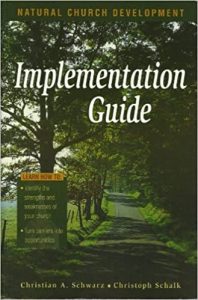
What does a church actually do to improve on the quality of its health characteristics, and in particular for its lowest characteristic? NCD is one of the few church health specialists that has a whole workbook produced for this purpose, the Implementation Guide to Natural Church Development.11 Included in the book is a section detailing “ten action steps” and another section on “how to improve your minimum factor” for each of the quality characteristics.
The strategic process, such as the one advocated by NCD, of analysing, reporting, recommending (solutions) and implementing (the steps), with a follow-up evaluation, is critical for all churches that desire to develop church health. However, addressing the “minimum factor” may not necessarily be the primary issue that a church needs to focus on. Sometimes the “minimum factor” is simply a symptom of a deeper issue or it may have at its source another primary issue that requires greater attention.
 This is where the organic-missional approach to church health needs to be seriously considered. The primary proponent of this approach is Neil Cole who wrote Organic Church: Growing Faith Where Life Happens.
 Colin Marshall and Tony Payne’s The Trellis And The Vine: The Ministry Mind-Shift That Changes Everything
 models of church.
 John Stott’s The Living Church: Convictions of a Lifelong Pastor
 In this article I will review two significant publications that represent each of these approaches. Due to the limitation on the length of the article, the second book in each approach is given less treatment than the first book. I conclude this review of church health literature with a discussion on how all three approaches together may help toward a greater understanding of church health.
 Another principle approach to church health is found in Stephen A. Macchia’s Becoming a Healthy Church: 10 Characteristics.
 While Wagner’s shift did not in itself precipitate the diversification of church growth teaching, it however, left an open field for new ideas about church growth to be introduced
 The second question I posed was: what are the irreducible principles for church growth? From the review of church growth literature, I believe they would be:
 As a result, the teaching on church growth that was already evolving became even more diversified. Thom S. Rainer’s The Book of Church Growth (1993) provides a very helpful overview of the history and diversification in church growth teaching.
 In a later book Strategies for Church Growth (1987) Wagner starts by revisiting some of the basic church growth principles. He explains how the advocates of CGM understand the terms commonly used in Christian circles. For example, what does “make disciples” mean? Wagner says that “The raw material of making disciples in the Great Commission sense is unbelievers who need to commit their lives to Christ for the first time. The raw material of modern ‘disciple making’ is Christians who need to be helped along the continuing road of Christian discipleship.”
 While pastoring I had read many books including Peter Wagner’s works on church growth, Rick Warren’s Purpose Driven Church, Christian Schwarz’s Natural Church Development, Thom Rainer’s and Eric Geiger’s Simple Church, Gary McIntosh’s One Size Doesn’t Fit All and Aubrey Malphurs’ Advanced Strategic Planning. They were instrumental in shaping my philosophy of church ministry. The way I led the churches under my care reflected my convictions. I had come to the conclusion that it was critically important for churches to be healthy so that they can grow. On hindsight, the Lord was already preparing me for a ministry of church consultation with a focus on church health.
 The work of church consultation in Malaysia faces a number of challenges.
 Let me give you four factors that will help you determine what you may write about, especially if it’s your first book.

 The event that sparked the writing of the book was a seminar I did for a young people’s church in October 2019. It was not my first time teaching the material. However, an evaluation the seminar made me realise that there was just too much material for the participants to digest. I decided that it would be better for me to put the teaching into a book so that people can read it at their own pace. They can also take time to think through the principles and apply them into their lives.
 Then, the final part—printing the book. A slot for early March had been set with the printer to print the book. It was rush time for the layout artist to get everything print ready by the deadline. We managed to do that by a whisker. The printer sent me a mock-up of the book for one final check. And even at that final stage there were still typo-errors. Corrections were made and the file was sent to the printers again with a go-ahead. Then came the MCO!…and a wait of nearly three months!