by Lim Soon Hock
A critical book review of Peter Rowan’s Proclaiming the Peacemaker: Malaysian Church as an Agent of Reconciliation in a Multicultural Society (Minneapolis, MN: Fortress Press, 2012).
The book review was an assignment for a course on Christian Theology, Culture and Church which I did as part of my DMin studies in 2022. Please forgive me for the academic style in which it is written. I hope reading my review will whet your appetite to read the book yourself.
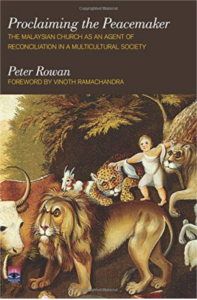 Thesis of the Book
Proclaiming the Peacemaker is about the church’s mission to proclaim Jesus as the Peacemaker and to act as an agent of reconciliation.1
It includes both vertical reconciliation with God and horizontal reconciliation with people2 (and ultimately with all things).3
The church’s effectiveness to fulfil the mission is predicated on its self-identity4 and readiness to suffer.5 Rowan’s thesis is discussed in the context of the multicultural but divided society of Malaysia.6 The author has a personal interest in the subject because of his life-experience in Northern Ireland where society is deeply divided.7
Secondly, he had lived and worked in Malaysia for about ten years as a seminarian, and had seen the relevance of the subject for Malaysia.8
Critical Review of Issues Raised in the Book
- The Theology of Mission and Reconciliation
In Chapter 1, the author concludes that reconciliation is a central theme in the New Testament9 that has both vertical and horizontal dimensions; with God and man respectively.10 He contends that theologians and missiologists have tended to emphasise on the former but failed to explore the latter.11
He explicates the foregoing with relevant Scripture,12 especially, from the Pauline epistles.13 His study of terms, such as “peace,” “forgiveness,” and “salvation,” further underscores their connectedness with “reconciliation.”14
Rowan states that reconciliation with God must necessarily mean reconciliation with people.15 His point is supported by public theologians, such as Paul S. Chung.16
Reconciliation, then, is first, vertically with God, and second, horizontally with His people. In Ephesians 2:14-18, Paul teaches that peace between Jewish and Gentile believers is only made possible because what used to be two peoples have become one new man in Christ.17 Hence, while peacemaking by Christians with non-Christians may be attempted, it may not, however, be easily achieved; simply because the primary vertical reconciliation with God is missing in one party.
The author, quoting Howard Marshall, is aware of the difficulty.18 Marshall’s answer is for Christians to acknowledge their shortcomings in promoting reconciliation, to repent of their hostile attitudes and actions toward others, to speak out against revenge, to know that they have the gospel of peace that the world needs, and to know that there are non-Christians who value reconciliation.19
Nonetheless, the reviewer maintains that in the context of Malaysia’s cultural diversity and dominance of Islam, the pursuit of reconciliation without compromising the gospel is challenging.
 Let me give you four factors that will help you determine what you may write about, especially if it’s your first book.

 The event that sparked the writing of the book was a seminar I did for a young people’s church in October 2019. It was not my first time teaching the material. However, an evaluation the seminar made me realise that there was just too much material for the participants to digest. I decided that it would be better for me to put the teaching into a book so that people can read it at their own pace. They can also take time to think through the principles and apply them into their lives.
 Then, the final part—printing the book. A slot for early March had been set with the printer to print the book. It was rush time for the layout artist to get everything print ready by the deadline. We managed to do that by a whisker. The printer sent me a mock-up of the book for one final check. And even at that final stage there were still typo-errors. Corrections were made and the file was sent to the printers again with a go-ahead. Then came the MCO!…and a wait of nearly three months!