
Author: Soon-Hock Lim
Who Leads the Church?
Of course, the Lord Jesus Christ, the Head of the Church leads the church. That’s not the issue. The issue is, who is or are the Lord’s appointees to lead a local church? That is one of the most common problems that have led to conflicts and disunity in churches.

Is it the pastor? The chairman? The Board (Council, Committee)? The Eldership? They are all legitimate possibilities. I am certain that the New Testament does not provide us with a blueprint for a Presbyterian, Episcopalian or Congregational church polity. What it does give us are some broad strokes of church leadership, especially the character, qualifications, roles, and functions of church leaders (1 Tim 3:1-13, 1 Pet 1:1-5). Guided by a biblical framework each church has the legitimacy to develop its own form of church governance.
Many books have been written and many scholarly discussions have contributed to the debate over church polity, and by extension, church structure. It is not my intention to revisit the arguments. From the broad strokes provided by the Bible, and especially the New Testament, I intend to argue for, one, team leadership, and two, “all things being equal”, for the pastor to lead the leadership team; and then, together they lead the church.
Team Leadership
“Power corrupts; absolute power corrupts absolutely,” is a sad fact; even in the church. Regardless of who is in charge. If too much power is coalesced in one person, the dangers of such abuse of power is very real. The leadership of the church should always be in the hands of a team of leaders with equal leadership authority. Nobody gets veto rights. Decisions are made collectively after careful deliberation and much prayer (not necessarily in that order). Plurality of leadership should be the order of the day.
 The New Testament is clear about the plurality of leaders. Paul instructed Titus to appoint “elders in every town” in Crete (Tit 1:5). Similarly, on their return leg of their first missionary journey, Barnabas and Paul “appointed elders for them in each church” in the cities of Lystra, Iconium and Antioch (Acts 14:21-23).
Church polity and structure differ from denomination to denomination, and from church to church. While there is no one-size-fits-all, there are however, good, better and terrible structures that either enhance or hinder the life and ministry of the church. Some church structures are so complicated that they literally smother the church; all in the name of “check and balance”.
There is no perfect system. In the end it boils down to the human factor. The spirituality, maturity, wisdom, and capability of the appointed church leaders is critical. And if they are the best men and women in the church, based on the foregoing criteria, then they must also be given the mandate to lead the church. While there are no guarantees, the church must trust the plurality of leaders to provide their own “check and balance”.
Team Leader
If having the leadership of the church vested in one person is wrong and dangerous, it is also just as wrong, and a reflection of poor leadership, to have a leadership team without a team leader. I believe that “all things being equal” the pastor should lead the leadership team.
 By “all things being equal” I mean that the pastor is just as capable, mature, spiritual, knows his Bible, and has leadership qualities as any of the other leaders in the church. If the pastor isn’t, relative to one or more of the other leaders, then, it is possible that another elder who is more qualified be appointed as the team leader.
There are good reasons for the pastor to lead the leadership team. First, the time factor. The typical pastor serves full-time. He (or she) is thus able to dedicate time to think, pray, and work through the issues of the church. Second, he has received formal training for the ministry. Third, because he is full-time, he is able carve out time to read, attend seminars, and avail himself for continual training so that he can further develop his shepherding and leadership skills. And fourth, his interaction with pastors of other churches allows him to learn from fellow-practitioners.
As I pointed out above, there is no full-proof system. However, based on the above reasons I believe the pastor makes the most suitable team leader for the leadership team and the church.
The Dynamics of a Group Bible Study Discussion

Elsewhere I have written that a small group Bible study is best conducted through discussion, and the role of the study leader is not as a teacher but a facilitator (see here). It may be helpful to understand how a discussion works by visualising the dynamics at play in a small study group.1
Teaching
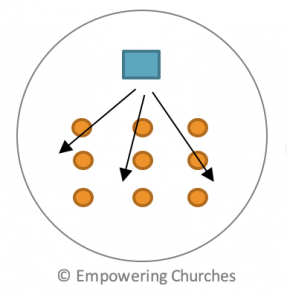 Let me begin by contrasting a teaching situation and a small group discussion. In the classic teaching set-up, the students sit in rows; everyone faces forward and looks at the teacher. They don’t see each other’s faces, only the teacher’s.
The “conversation” is primarily one-directional and a monologue—from teacher to students. The students may raise questions, but only the teacher is expected to give the answers. The teacher is the primary (and often, the only) source of learning for the group.
Discussion
A discussion is depicted diagrammatically (and literally) with all the participants sitting in a circle. The study leader is part of the circle. Sitting in a circle allows everyone to see each other, look into each other’s eyes, observe expressions, engage, and relate with one another.
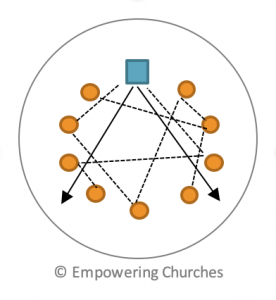 It is not a good idea to have more than one layer of people. No one should be sitting behind another person. Everyone should be able to have eye-contact with every person in the group.
This is especially necessary for the leader who uses eye-contact to convey connection and attention as well as understanding and acceptance to the other participants. More than that, when he (or she) is able to see everyone’s face he is able to read their body language. Are they lost, bored, engaged, or ready for an opportunity to contribute to the conversation?
In a discussion, the study leader leads and facilitates the dialogue (depicted by the full lines). However, the goal is to get everyone to participate and contribute to the discussion (depicted by the dotted lines).
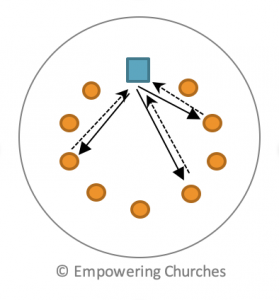 What is important to note is that the lines of communication are not just between the leader and the others, but also between the members of the group. If the conversation were just between the leader and each member, then the dynamics would be a “quiz”. The leader asks a question and someone responds. Then, back to the leader who follows up with a comment and/or another question. The cycle is then repeated. In this case, the leader is not functioning as a facilitator but a quiz master. However, a discussion, by definition, is only assumed to have taken place if members of the group interact with one another. One of the key jobs of the study leader then is to facilitate this interaction between members.
Discussions are Tailored-Made for Cell Groups
Preaching, teaching, and discussion have their particular usefulness. All these means of learning should be employed in the church. Which method is used, however, depends on one, the purpose of the engagement and two, the setting of the learning environment. I won’t repeat what I have written elsewhere (see here).
In the context of a small group or cell group, I believe the primary means of learning should be through discussion—not preaching or teaching. Churches would do well to train all who are tasked with the job of leading the cell group Bible study to ably facilitate good discussions. Discussions that are interesting and engaging. Discussions that help members discover and uncover what the Bible says about the subject under study. And discussions that provoke personal reflection and encourage life application.
The Critical Point when Facilitating a Group Bible Study Discussion
In my previous blog post I explained why conducting Bible study through small group discussion is a good thing (see here). For one, it fosters active learning. Secondly, it has the advantages of group learning. And thirdly, it is more interesting than listening to a monologue.
The Role of the Study Leader
The role of the study leader then, is not that of a preacher or teacher, but a facilitator. He or she facilitates a discussion around (or about) the topic (or Bible text). But it is not a conversation that’s just goes around in circles. A discussion has progression (or direction) that ultimately leads to a clear outcome (or conclusion).
 In this regard, the study leader steers the conversation around the topic. He guides the members to make contributions that are relevant to the focus of the study. If the discussion goes awry, the leader brings it back on track. If the discussion gets stuck, he moves it along. If a member of the group isn’t contributing to the conversation, he encourages him or her to participate. If someone is hogging the conversation, he tactfully gets others to share. At the end of the study, he brings the discussion to a close with a clear conclusion; including a take home point from the study.
The Method of the Study Leader
The study leader has many tools at his disposal to accomplish the above. It bears repeating that the leader’s job is not to preach or teach; his job is to facilitate a group discussion. As the group does this, they discover together; the meaning of a Bible text or what the Bible has to say about a certain topic. To aid the group in the process of discovery and to enable the facilitator to carry out his role, one of the most important tools the leader uses are questions.
Questions to help the members study the Bible text; questions of observation, interpretation, and application. Questions to move the conversation along. Questions to get a member to clarify his point or expand on what he said. And questions to get the group to think more deeply about a certain point.
 The study leader is often temped to answer his own questions, especially when the group is slow to respond. But he must strongly resist! It wouldn’t be a discussion if the leader were to pose a question only to supply the answer himself. This does not mean that the leader does not come prepared with answers. He does. But he only shares it when it’s necessary to do so or by way of rounding off a segment of the discussion and as a conclusion to the study.
Question Techniques
Here are some dos and don’ts for discussion leaders regarding asking questions:
- Avoid questions that assume an answer.
- Avoid questions that can be answered with a simple ‘Yes’ or ‘No’.
- Avoid questions that are too simple.
- Ask one question at a time. Ensure that the question is clear and focused on one specific item.
- Don’t be afraid of some silence. Resist answering your own questions too quickly.
- Ask questions, then direct them.
- Answer questions coming from the group with another question.
- Redirect questions.
- If questions come in a rush, sort them out and deal with them individually.
- Respond to wrong and irrelevant questions tactfully.
- Respond to difficult questions or questions asked at a wrong time by deferring them.
- Keep the discussion going by:
-
-
- Asking for further responses from others.
- Follow up on responses with another question.
- Look out for members who show signs of wanting to say something, especially if they are usually quiet, and give them an opportunity to contribute to the discussion.
-
Bottom line: The group Bible study leader facilitates a discussion by asking good and relevant questions.
You may want to read my article “The Dynamics of a Group Bible Study Discussion.“
Same Word, Different Ways

Christians grow in the Word through four primary ways: sermons, Bible classes, small group discussion, and personal study (including daily devotional reading). They are all important, and none should be neglected.
They have the same ultimate objective – a believer’s growth in the Word (understanding) and through the Word (transformation). However, they don’t do it in the same way. The failure to distinguish them is one of the main reasons why sermons or small group Bible studies don’t impact people as much as they could.
The Sermon
 For example, the main purpose of a sermon is not about piling onto the listeners loads of biblical knowledge. Growth in Bible knowledge is more in line with teaching. This is not to say that a sermon has no teaching content. A sermon cannot qualify as a sermon if it is not biblically sound. A sermon must be based on teaching (biblical teaching); but a sermon is not teaching. The purpose of a sermon is to convey God’s message from the Bible. It is a word from God from the Word of God—a message from the passage. The purpose of a sermon is to speak into lives; to encourage, inspire, and correct; leading to life transformation (2 Tim 3:16-17).
If that is the case, then preachers should not pack their sermons with loads of teaching material filled with multiple points and sub-points. To those who do, they should teach less and preach more. Conversely, preachers who tend to preach a point rather than from the biblical text, should make sure that their sermons are based on and derived from the biblical text; preferably from one main passage of the Bible.
Another mark that differentiates preaching from other forms of Bible learning is that a sermon does not allow for much, if any, “conversation” between the preacher and the listeners. This is simply because the nature of a sermon is proclamation rather than dialogue. Secondly, the setting of speaking to a crowd limits any kind of actual dialogue between preacher and listener.2
The Bible Study Discussion
On the other hand, the small group Bible study functions in the opposite way. The study leader is not a preacher; not even a teacher. The role of the study leader is to facilitate a discussion where all the members of the group are encouraged to contribute. The operative word is “discussion”.
There are many good reasons for the use small group discussion to study the Bible.
 A discussion is active learning through participation. Listening to sermons and Bible teaching are passive forms of learning. It is well documented that people learn better through active participation rather than passive listening.
- In a discussion people are made to carefully think, or closely observe the Bible text before they respond. Similarly, they have to intently listen to what the others in the group are saying in order to meaningfully participate in the conversation.
- A discussion affords group learning as the members weigh each one’s contribution to the discussion.
- A discussion is more interesting than listening to a monologue. This is especially true if the Bible study leader, say, for a particular cell group meeting, is not a gifted teacher.3 In a discussion, however, regardless of the leader’s level of gifting as a teacher, everyone is invited to participate. It inevitably creates more interest. For example, a view may be shared, which may be affirmed, refuted or refined by others. All this leads to a vibrant group conversation.
I believe most people are able to lead a discussion. Training on how to conduct a group Bible study discussion will certainly help. Following some key pointers on how to conduct a discussion is sufficient for anyone to comfortably lead a discussion. I will write more on this in my next blog post.
You may want to read my article “The Critical Point when Facilitating a Bible Study Discussion.”
Is Your Sermon Predictable?
 What is a Predictable Sermon?
Predictability is foreseeing an expected outcome. In the case of a sermon, it becomes predictable when listeners can generally foresee what the preacher is going to say. It may be due to the sermon’s obvious content. Or it may be because the sermon is not only about a well-known Bible subject or text, it is also approached in a rather usual or common way. Or it may be because the preacher has already disclosed the sermon’s main point or points very early in his presentation. All the above scenarios make the sermon predictable.
An example of a predictable sermon comes from the fairly common sermon structure that goes like this:
- Introduction: Tell the listeners what you are going to say
- Body: Tell them in a more detailed way what you told them you are going to say (elaboration)
- Conclusion: Tell them what you just said (summary)
The above structure might be good for teaching—but not for preaching. In the main, teaching is to provide information and understanding about a biblical subject or text. Hence, the above structure is useful to give clarity to the student about what is going to be taught, what is being taught, and what has been taught. This is not to say that preaching does not provide understanding about a biblical subject or text, but the understanding is meant to inspire, encourage, challenge, and change the listener. A sermon must engage both the mind and heart of the listener. Thus, creating and maintaining the interest of the listener is critical.
What’s the Problem with a Predictable Sermon? 
The problem with a predictable sermon is that it takes away the listeners’ sense of anticipation for what the preacher has to say (because they already know what he’s going to say). There isn’t a “wait for it…,” intrigue, or a surprise element. When there is little or no sense of anticipation, there will be little or no interest to listen to the sermon.
If a listener is quite well acquainted with the subject matter or has little or no immediate interest in the subject matter, the preacher would have already lost him by the end of the introduction. It is likely that the listener will only wake up when the preacher tells a story, gives an illustration, or cracks a joke! The sermon as a whole does not hold the listener’s attention (that is, interest) because he (or she) is not given any reason to listen with any sense of anticipation.
I believe it is important for every preacher to ask, as he (or she) prepares his sermon, if what he’s going to say next in the flow of his sermon, predictable?
How to Break Predictability in the Sermon?
If predictability is unhelpful to create and maintain listener-interest, then, a preacher must find ways to move away or break the listener’s sense of sermon-predictability. A good starting point is to stop using the sermon structure cited at the beginning of this article. Instead develop sermon structures that do not give away the main thrust of the sermon (namely, the message) until much  later. That is to say, there is a “wait for it” element in the movement of the sermon. Some teachers of homiletics have called this movement, “tension and resolution.”
It can be easily seen that predictability is broken and interest is created when a sermon contains a tension to be resolved, a mystery to be uncovered, or a question to be answered. To maintain listener-interest, the resolution should not come too soon. The first part of the sermon should be given toward building up the tension. And the later part of the sermon, to the resolution of the tension. It is even possible to have the resolution right at the end—as the key message of the sermon.
To be sure, the tension, the mystery, the question nor the resolution are plucked from the air; they arise from the Bible text that the preacher is speaking from. In other words, Bible-centred preaching is not compromised in any way.
I believe that if a preacher wants to create and maintain listener-interest, his sermon cannot afford to be predictable. His sermon structure and presentation must be such that it causes his listeners to lean in with an anticipation of discovery.
Making a Difference
(This was something I wrote more than ten years ago as part of the introduction for a book that never got published [not yet, anyway]. I think it’s worth a read.)
I had read some of John Maxwell’s books, but this would be the first time I would be meeting him personally. This was in August 2004, when I was invited to a dinner meeting where Maxwell would be introducing the Million Leaders Mandate (MLM) curriculum to Malaysia and Singapore. The purpose was to interest potential Associate Trainers to take the programme into Asia.
After dinner, while still recovering from jet lag, Maxwell got up and gave a most inspiring message. I have since picked it up. As I go around conducting Train The Trainers (TTT) for MLM I have tried to pass on that same message, illustrating the points with my own personal stories.
————————————————————————————————————————————-
 Apart from the Lord’s call, the reason I entered full-time Christian ministry was because I wanted my life to make a difference. Maybe at that point in time I didn’t think of it in that precise term. However, what was true was that my life had been transformed by the Gospel and all I wanted to do with my life was to bring that same transforming message to others.
During that time, I had been studying and living in New Zealand for seven years. I could have applied for permanent residency, as it was not difficult to get one back in the late ‘70s and early ‘80s. I never did because the Lord had already made it clear to me, “Return to your home and declare how much God has done for you” (Luke 8:39). I was determined that I would not allow a rope to tie me down or a bridge to entice me to go back—I wanted my life to make a difference.
Making a Difference with People
All pastors and church leaders will agree; we want our lives to make a difference. That is why we preach, counsel, and pray for people. However, if we are serious leaders we would have to ask the question: But what kind of a difference? Is it to grow a huge church with thousands in attendance? To be revered as the man who was responsible for a magnificent church building? Or, to be known for an international ministry?
Over the years I have grown to learn that far more important than the size of building, budget and bodies—it is people. I want to make a difference with people. People are what count in the Kingdom of God. People are eternal. People influence people. Therefore, to invest in the lives of people is the best investment of my time, energy and other resources. Oswald Sanders stated that leadership is influence. And if by the grace of God, we can influence people for God, the Gospel and godliness, we will have already made a great difference.
Who Want to Make a Difference
I have since learnt, that as a leader I need to go beyond that. Yes, I want to make a difference with people. But what kind of people? Taking a cue from 2 Timothy 2:2; as a leader, I want to make a difference with people who want to make a difference.
Over the last few years that is what I’ve been doing; much more consciously and intentionally. Whether basic discipleship or leadership development, I look out for people who want to make a difference with their lives, and then I invest my life in their life. This is no quick fix two-hour seminar, but a long-term investment. It is more arduous and time consuming but I have no doubt that they will pay dividends, because these lives are going to make a difference. Maybe not immediately, but certainly sometime in the not-too-distant future.
As a result, I have people who are now making disciples. I also have a number of home-grown people coming on board the church staff. Since I am a pastor, and my work is in the context of a church, inevitably the people I influence largely end up doing church related work. However, I dream that my influence will also extend to members of the church who are intentional about impacting their marketplace.
Doing Things that will Make a Difference
“Doing what?” Whether it’s in the church or in the marketplace I want to make a difference with people who want to make a difference doing things that will make a difference.
There’s a young lawyer in my church who can’t stand injustice and he will do all he can to fight it. Clearly, he wants to do things that will make a difference. He has a good heart but he could do with some help in understanding what the Bible has to say about justice and to develop godly ways of achieving it. I wish I could empower someone like that.
I also have a YB4 in my church who is in the opposition camp. He’s a good man, with a good mind and who speaks sensibly in Parliament. He’s someone whom I would vote for any day. He is certainly someone who wants to do things that will make a difference. I wish I could influence someone like him whose time in Parliament can make a difference for our nation.
At a Time that will Make a Difference
This is what leadership is all about. The priority at this stage of my life and ministry is to make a difference with people who want to make a difference, doing things that will make a difference, and at a time that will make a difference. And the time is now!—as it has always been. It is not a mistake nor by chance that we were born in this country and at this time of the nation’s history. I don’t need to tell you the stories of Joseph, Esther, Daniel and the many others—who were God’s man and God’s woman in God’s place at God’s appointed time to do God’s ordained work.
Malaysia needs Christian leaders from all walks of life and in all spheres of society. I believe with all my heart that we, and I do mean all Christians, can make a difference!
A Church’s History and Its Present Health
Can Past Events and Experiences of a Church Affect Its Health?
 I believe most observers of churches will agree that events in the history of a church can have a long and lasting effect on its health. That is, positive past experiences serve to strengthen a church’s health, while negative past experiences cause damage to its health.
As with the human body, so with the church body. A painful experience in a person’s life can affect his health in some way (emotionally, psychologically, spiritually, and or physically). Similarly, a negative event in the life a church can also affect its health.
And yet, hardly any church looks into its history and, much less, deals with the negative and painful events of its past.
In His letters to the seven churches of Asia (Rev 2-3), the Lord might appear to be just describing the present condition of the churches and telling them what they needed to do to get back into shape.
It is obvious, however, that they did not arrive at their present condition overnight; it had developed over time. The basic cause or root problem originated sometime in the past. For example, the adulteration of Pergamum’s beliefs with the teaching of Balaam and the Nicolaitans (Rev 2:14-16) started at some point in time by someone at a certain event. As these false teachers and teachings were not rejected at the onset nor addressed subsequently, they became entrenched in the church.
How Past Events Affect a Church’s Health
The acceptance of wrong teaching is just one of many possible reasons for a church’s poor condition. Conflicts and disunity, such as in the Corinthian church (1 Cor 1:10-13), is not unusual in churches across the globe today. And when it reaches a critical point, it often leads to a church split. This might result in the establishment of a new church, but it is one that is born out of strife. And the church carries with it the trauma and the bitter spirit by which it was birthed.
At the same time, the original church suffers just as much. It is also straddled with trauma and carries with it the same bitter spirit. It is not surprising when the church is beset with poor health. Nor is it surprising when the new church experiences conflicts and disunity, and perhaps even its own church split later on. When that happens, what we have is a pattern that is now entrenched into the spiritual psyche of the church.
The happy point to note, is that, the reverse is just as true. Past good events such as a spiritual, ministry or financial breakthrough, seasons of successes and revivals, and the like, empower the church towards greater health. The life of the church is marked by love, faith, and hope.
 Plotting a Church’s History
I am convinced that it is necessary to look seriously into a church’s history, to analyse the effects of both positive and negative experiences of the church (but especially, the latter) on its health.
One helpful way to determine if a church’s history has affected its health is to list all critical happenings in its history. It should include both good and bad experiences. For example, a breakthrough in a church’s outreach to its local community is a positive experience, while the unhappy termination or resignation of a pastor is a negative experience. This list of happenings is then plotted on a timeline.
Secondly, plot the annual numerical growth of the church on a timeline, from the time of the church’s inception till the present. Then finally, superimpose the church’s happenings in its history against the church’s growth chart. From this, an analyst will be able to note causes and effects, and the ensuing patterns. A careful analysis of this primary data will determine if the church’s past experiences have affected its health. Furthermore, the analysis will help uncover the reason(s) for the church’s health condition.
An analysis is not the solution, but it is the prerequisite to seek the Lord for the right thing to do to bring healing, restoration, and renewal to the church.
Church Health Analysis Consultation
Why? Jesus, the Lord of the church, expects His church to be healthy and growing (Eph 4:11-16). Studies have shown that healthy churches grow; certainly, in quality, and often, numerically. It is, therefore, incumbent upon every church to attend to its health.
To develop better health, a church needs to first determine its present level of health, strengths and weaknesses, and the contributing reasons for them. Only then, can it take the right steps to strengthen its health.
The analysis of a church’s health is carried out by using a diagnostic instrument called CHART: The Church Health Analysis & Revitalisation Tool. This is a unique instrument that the analyst developed for his Doctor of Ministry project which he completed in 2024. It has been field tested and proven to be reliable and accurate.
CHART. The Church Health Analysis & Revitalisation Tool is a comprehensive church health diagnostic instrument.
The primary component of the instrument is the quantitative survey questionnaire that everyone in the church are encouraged to participate. Three other parts provide supportive and collaborative data. They are: the church’s statistical data, interviews with church leaders and members, and the analyst’s personal observation during an onsite visit(s) of the church.
CHART’s analysis of the church is based on three aspects of the church: the nature, ministry, and organisation of the church. Under these aspects of the church, CHART measures 12 related church health characteristics; three under nature, six under ministry, and three under organisation.
The process of collecting, collating, and analysing the data, and writing the church health report will take six to eight weeks.
 The Analyst. Rev. Dr. Lim Soon Hock is a certified church consultant with the Society for Church Consulting (USA; website: https://churchconsulting.org/). He has had about 30 years of pastoral ministry that includes being the Senior Pastor of Georgetown Baptist Church, Penang, and PJ Evangelical Free Church, Petaling Jaya.
Soon Hock completed a Doctor of Ministry from the Malaysia Baptist Theological Seminary, Penang in 2024. For his doctoral project he developed a unique church health diagnostic instrument called CHArT: The Church Health Analysis Tool. In 2014, he founded Empower Services & Consultancy as a vehicle to pursue his God-given vision to empower pastors, church leaders, and churches through church consulting.
For a preliminary discussion on conducting a church health analysis for your church please write to Soon Hock at empoweringchurches.my@gmail.com.
Church Health Analysis Training Module
 Why? Jesus, the Lord of the church, expects His church to be healthy and growing (Eph 4:11-16). Studies have shown that healthy churches grow; certainly, in quality, and often, numerically. It is, therefore, incumbent upon every church to attend to its health.
To develop better health, a church needs to first determine its present level of health, strengths and weaknesses, and the contributing reasons for them. Only then, can it take the right steps to strengthen its health.
The Church Health Analysis Training Module will give a church health analyst a biblical understanding of church health and equip him or her with a powerful tool to conduct a comprehensive church health analysis.
The diagnostic instrument is called CHART: The Church Health Analysis & Revitalisation Tool. The module includes training for a church health analyst to competently use the instrument.
What? The module covers:
- Church health: Its biblical & theological basis
- Church health analysis: Its purpose & goals
- Church health characteristics
- CHART: Model & framework
- Training in the use of CHART to conduct a comprehensive church health analysis
- Issues related to and have effect on a church’s health, such as: church culture, history of the church, church organisation & structure, and systems & processes
Pre-requisites. The participants must:
- Be recommended by denominational leaders
- Have basic theological training
- Be experienced pastors or church leaders
- Have a credible track record in church ministry
The Trainer. Rev. Dr. Lim Soon Hock is Malaysia’s first certified church consultant with the Society for Church Consulting (USA; website: https://churchconsulting.org/). He has had about 30 years of pastoral ministry that includes being the Senior Pastor of Georgetown Baptist Church, Penang, and PJ Evangelical Free Church, Petaling Jaya.
Soon Hock completed a Doctor of Ministry from the Malaysia Baptist Theological Seminary, Penang in 2024. For his doctoral project he developed a unique church health diagnostic instrument called CHArT: The Church Health Analysis Tool. In 2014, he founded Empower Services & Consultancy as a vehicle to fulfil his God-given vision to empower pastors, church leaders, and churches through church consulting. C
For a preliminary discussion on the Church Health Analysis Training Module please write to Soon Hock at empoweringchurches.my@gmail.com.